On January 23, 2026, the National Park Service dismantled the slavery exhibit at the President’s House in Philadelphia — the site where George Washington held nine enslaved people — citing a Trump executive order. A federal judge called it Orwellian censorship. The panels were partially restored. The fight over what America is allowed to remember about itself is not new. What is new is the federal government doing the erasing.
The President’s House Site at Philadelphia’s Independence National Historical Park has 34 interpretive panels. Thirteen of them address nine specific human beings: Austin, Paris, Hercules, Christopher Sheels, Richmond, Giles, Oney Judge, Moll, and Joe — enslaved by George Washington and brought from Mount Vernon to Philadelphia in 1790 when it was the nation’s capital. They cooked, cleaned, did laundry, tended horses, cared for grandchildren, and waited on the Washingtons. Oney Judge escaped in May 1796 and later gave interviews to abolitionist newspapers in the 1840s — one of the few documented first-person accounts of enslaved life in the Washington household.
The exhibit took 24 years of advocacy to build. It took one executive order to dismantle.
THE REMOVAL
On March 20, 2025, President Trump signed an executive order titled “Restoring Truth and Sanity to American History,” directing the removal of materials deemed “disparaging” from federal sites and the reinstatement of Confederate monuments removed during the George Floyd protests. On January 23, 2026, National Park Service workers took down the slavery panels at the President’s House, citing the order.
The City of Philadelphia sued the Department of Interior. U.S. District Judge Cynthia M. Rufe issued a preliminary injunction, likening the removal to Orwellian censorship — a direct invocation of the Ministry of Truth in 1984, the government agency whose function was to rewrite the past. By February 20, 2026, approximately half the panels had been restored under court order. Rep. Brendan Boyle introduced legislation to protect the site from future removal.
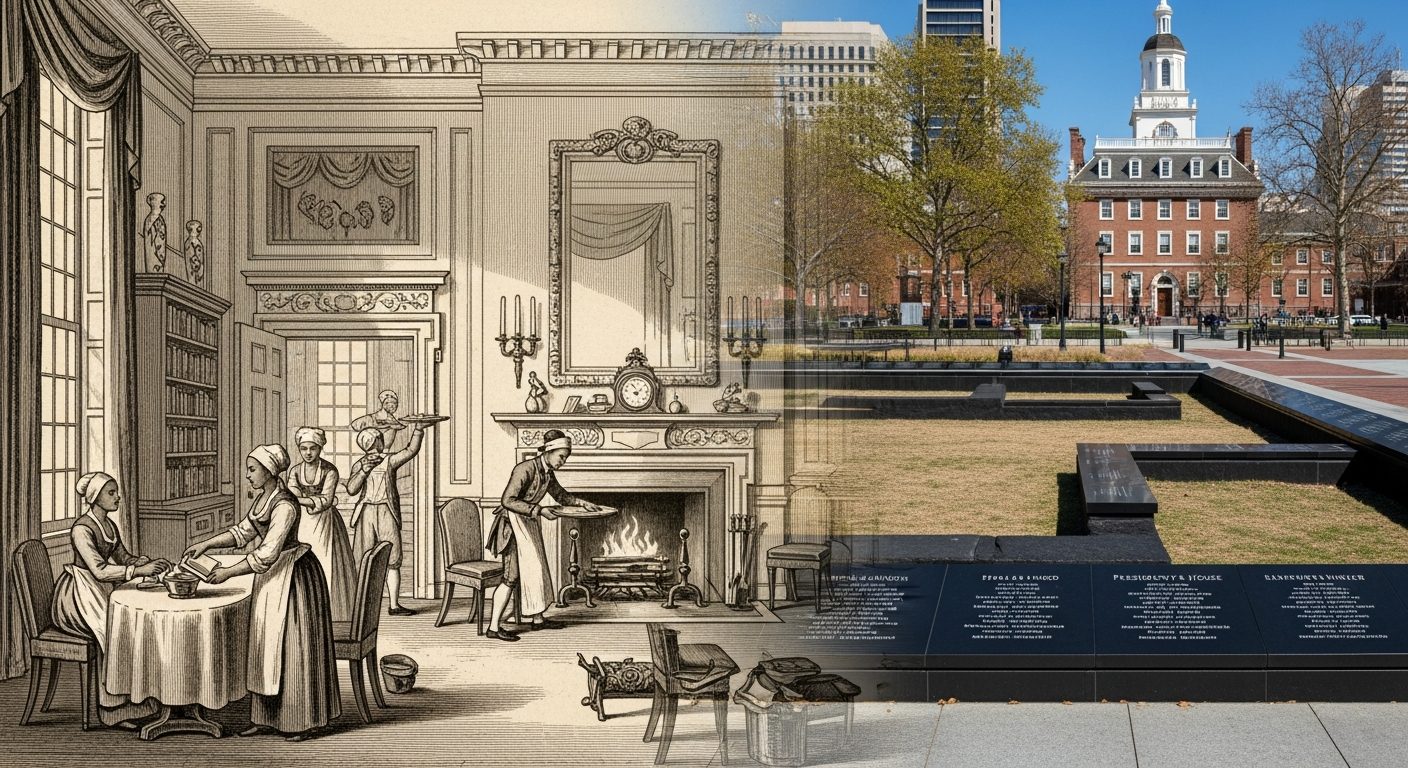
The same ground: enslaved people worked here in 1790. Interpretive panels explained this for 15 years before being removed on federal order in January 2026.
THE BROADER PATTERN
The Philadelphia removal is not an isolated incident. The same executive order directing federal agencies to reinstate Confederate monuments — symbols of the Confederacy’s explicit defense of slavery, removed by communities after 2020 — while simultaneously removing panels documenting actual enslaved individuals by name defines the administration’s position clearly: Confederate monuments are history worth preserving; documentation of the enslaved is “disparaging.”
Florida’s state curriculum standards, adopted in 2023 and still in effect, teach that slavery gave enslaved people “skills” they could use for “personal benefit.” Texas introduced a new social studies curriculum in 2024 that historians and parents documented as glossing over slavery and racism. Trump’s January 2025 executive order “Ending Radical Indoctrination in K-12 Schooling” threatens to withhold federal funding from schools that teach DEI-adjacent content. The 1619 Project — the New York Times’ Pulitzer Prize-winning examination of slavery’s role in American founding — was the direct target of the Trump administration’s 1776 Commission in 2020, which produced what the administration called a “dispositive rebuttal.”
WHAT THE EXHIBIT ACTUALLY SAYS
The President’s House exhibit does not argue a political thesis. It names nine people, documents their work, and identifies the building where they lived and labored. Oney Judge’s story — enslaved from birth, brought to Philadelphia at 17, escaped at 22, gave interviews as a free woman decades later — is not an accusation. It is a biography. The panels were created in 2010 after historian Michael Coard discovered in 2002, while researching Independence Hall, that Washington had held enslaved people on this specific site. The exhibit exists because the history was there and had simply not been acknowledged.
A federal judge used the word “Orwellian” to describe its removal. That word has a specific meaning: the alteration of the historical record by institutional authority to serve current political purposes. The judge’s framing was precise.
Sources: NPR (NPS dismantles slavery exhibit, Jan 25, 2026); 6ABC Philadelphia / NBC Philadelphia (restoration, Feb 2026); PBS NewsHour (exhibit returns, Feb 2026); National Park Service (enslaved people at Independence Hall); White House Historical Association (Washington’s enslaved household); Axios (Trump Confederate monuments executive order, Mar 2025); ABC News (Trump removes slavery memorial); CBS News (Florida slavery curriculum “skills” standards); Texas Tribune (Texas curriculum controversy, Nov 2024); Historian Michael Coard — documented in NBC News (24-year advocacy campaign)