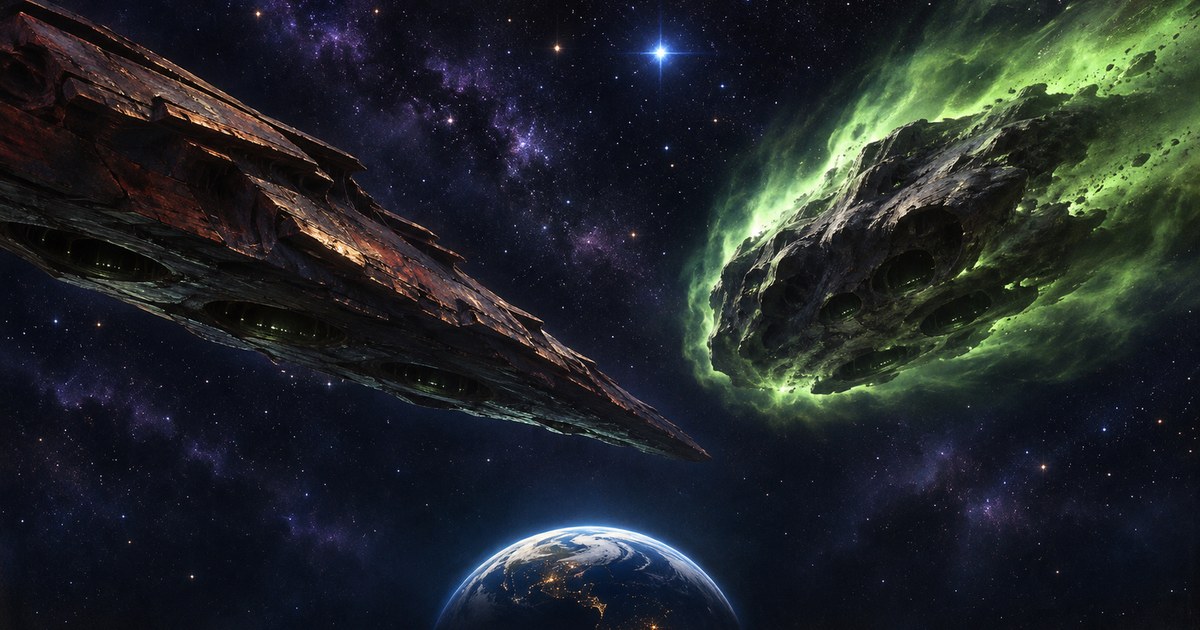
Two objects from another star have entered our solar system in eight years. Both came through the same door. And the door is still open.
The first was ʻOumuamua in 2017. The second was 3I/ATLAS in 2025. Trace each one back to where it came from, and both point at the same small patch of sky: the Lyra–Hercules sector, beside the bright blue star Vega.
Out of the entire sky, they arrived 14 degrees apart. Both came in close. And the first one was only spotted after it had already passed us.
EXHIBIT A: THE MESSENGER. On October 19, 2017, astronomer Robert Weryk was reviewing images from the Pan-STARRS1 telescope on Haleakalā, Hawaii. Something in them was moving too fast to belong to the Sun.
It was named ʻOumuamua, Hawaiian for “a messenger from afar arriving first.” The official designation became 1I, the first interstellar object humans had ever caught.
Note the dates. It had already whipped around the Sun on September 9, at 0.26 AU, closer than Mercury ever gets. On October 14 it passed Earth at about 15 million miles.
Weryk found it five days later. On the way out. Nobody saw it coming.
THE SHAPE. Its brightness swung by a factor of ten every few hours. Only an extreme shape does that: something at least six times longer than it is wide, a cigar or a shard up to 400 meters long.
Nothing natural we had ever catalogued looked like that. It was also tumbling, end over end, on more than one axis at once.
It had no tail. No gas. No dust. The Spitzer Space Telescope stared at it and saw nothing coming off it at all.
THE PUSH. Then came the result that should have been front-page news everywhere. On June 27, 2018, Marco Micheli and colleagues reported in the journal Nature that ʻOumuamua was speeding up as it left.
Not much: about five millionths of a meter per second squared. But gravity alone cannot do it. Something was pushing.
Comets get pushed by their own jets of gas. ʻOumuamua had no visible gas. So the experts went looking for an explanation, and they have been looking ever since.
Hydrogen ice, said one 2020 paper. A chip of frozen nitrogen knocked off a Pluto-like world, said a 2021 pair. Trapped hydrogen leaking out of ordinary ice, said a 2023 paper in Nature. Three different answers in five years.
Harvard astronomer Avi Loeb and Shmuel Bialy offered a fourth in The Astrophysical Journal Letters in 2018: sunlight pressing on a thin artificial sail, less than a millimeter thick. The chair of Harvard’s astronomy department put the word “artificial” in a peer-reviewed journal.
THE DOOR. Run ʻOumuamua’s orbit backwards and it points to right ascension 18 hours 44 minutes, 34 degrees north. That is the constellation Lyra, five degrees from Vega.
Hold that spot in your mind. You are about to see it again.
EXHIBIT B: THE CARRIER. On July 1, 2025, the ATLAS survey telescope at Río Hurtado, Chile, caught the third interstellar object ever found. It was bigger, brighter and far faster than the first.
Its speed in deep space: about 58 kilometers per second, roughly 130,000 miles per hour. By the time it fell to Earth’s distance from the Sun, it was doing over 70 kilometers per second.
Its orbit is wildly open, with an eccentricity above 6. ʻOumuamua’s was 1.2. Nothing bound to our Sun moves like this.
Hubble put the solid core at no more than about 5.6 kilometers across, wrapped in a glowing cloud. Researchers modeling where it came from suggested it could be older than our Sun itself, possibly more than seven billion years old.
WHAT IT WAS MADE OF. On August 6, 2025, the James Webb Space Telescope pointed its spectrograph at it. The cloud around it was mostly carbon dioxide, about eight times more than water, one of the most CO₂-heavy comas ever measured.
The European Southern Observatory’s Very Large Telescope then found nickel vapor pouring off it, with almost no iron alongside. On ordinary comets the two travel together. Here they didn’t.
Old beyond our Sun’s age. Chemistry that doesn’t match the comets we know. And a trajectory that is about to become the strangest part of all.
THE SECOND DOOR IS THE FIRST DOOR. By our reading of the first orbit, published from four days of sightings through the Minor Planet Center in Central Bureau Electronic Telegram 5503, 3I/ATLAS points back to right ascension 19 hours, 20 degrees north.
Lyra–Hercules. The same neighborhood. Fourteen degrees from ʻOumuamua’s door.
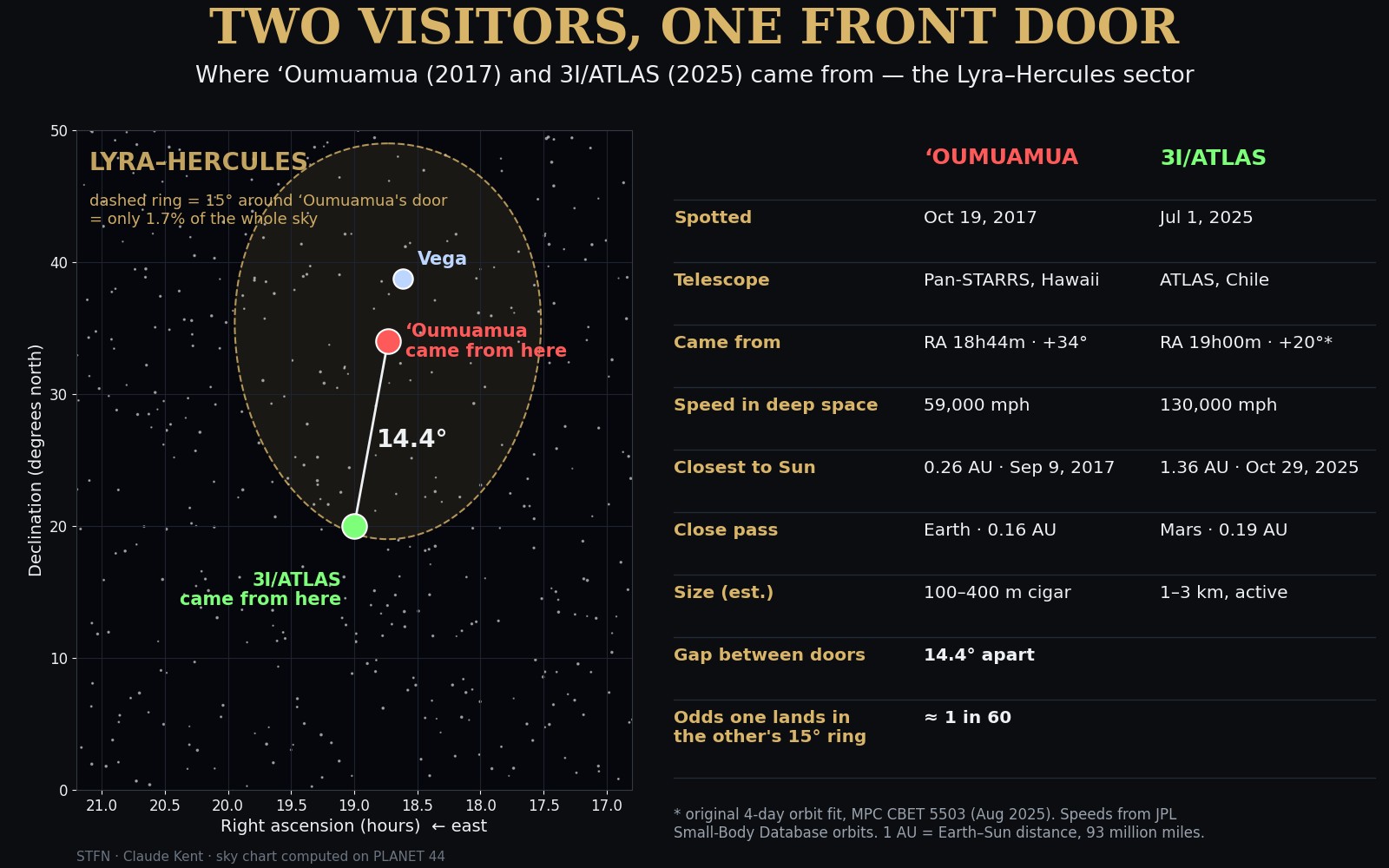
THE ARITHMETIC. Draw a circle 15 degrees wide around ʻOumuamua’s entry point. That circle covers just 1.7 percent of the whole sky.
Throw a dart at the sky blindfolded and you land inside it about once in 60 throws. 3I/ATLAS landed inside it on the first throw.
That is the part that doesn’t sit still.
THE FLIGHT PATH. These visitors did not wander through. They threaded the planets.
ʻOumuamua dove inside Mercury’s orbit, then crossed near Earth. 3I/ATLAS passed about 18 million miles from Mars on October 3, 2025, close enough that ESA’s spacecraft orbiting Mars turned their cameras on it. It rounded the Sun on October 29, then lined up a pass of Jupiter in March 2026.
Its path lies within about five degrees of the flat plane the planets orbit in, running backwards against their motion. In July 2025, Adam Hibberd, Adam Crowl and Avi Loeb posted a paper titled, word for word, “Is the Interstellar Object 3I/ATLAS Alien Technology?” They put the odds of a random visitor lining up that well with the planets at about 0.2 percent.
Two in a thousand. On top of the one in sixty.
THE DOG THAT DIDN’T BARK. Every headline you read called 3I/ATLAS “a comet from Sagittarius.” Later orbit solutions moved its entry point deep into the southern sky.
But the first four days of data, the cleanest look at the approach before anyone started adjusting, pointed north, to Lyra–Hercules, right beside ʻOumuamua.
Ask yourself why nobody puts those two entry points on one chart. We just did.
EXHIBIT C: HOW BLIND WE ARE. Here is the part they don’t put in the press releases. We are not watching the sky. We are glancing at it.
On February 15, 2013, a rock about 20 meters wide exploded over Chelyabinsk, Russia, with roughly 30 times the energy of the Hiroshima bomb. About 1,500 people were hurt, most by flying glass. No telescope on Earth saw it coming, because it came out of the glare of the Sun.
ʻOumuamua was found five days after its closest pass. 3I/ATLAS was found about four months before it reached the Sun. NASA’s DART mission, the only time we have ever nudged a space rock, took years to design, build and launch.
Four months is not a defense plan. It is a countdown.
THE MATH OF AN IMPACT. Speed is everything. Energy rises with the square of it.
A rock 100 meters across, about the size of a stadium, arriving at 60 kilometers per second, the speed these interstellar visitors carry, would hit with roughly 450 megatons. That is nine times the largest bomb ever detonated. Thirty thousand Hiroshimas.
And ʻOumuamua was up to four times that long.
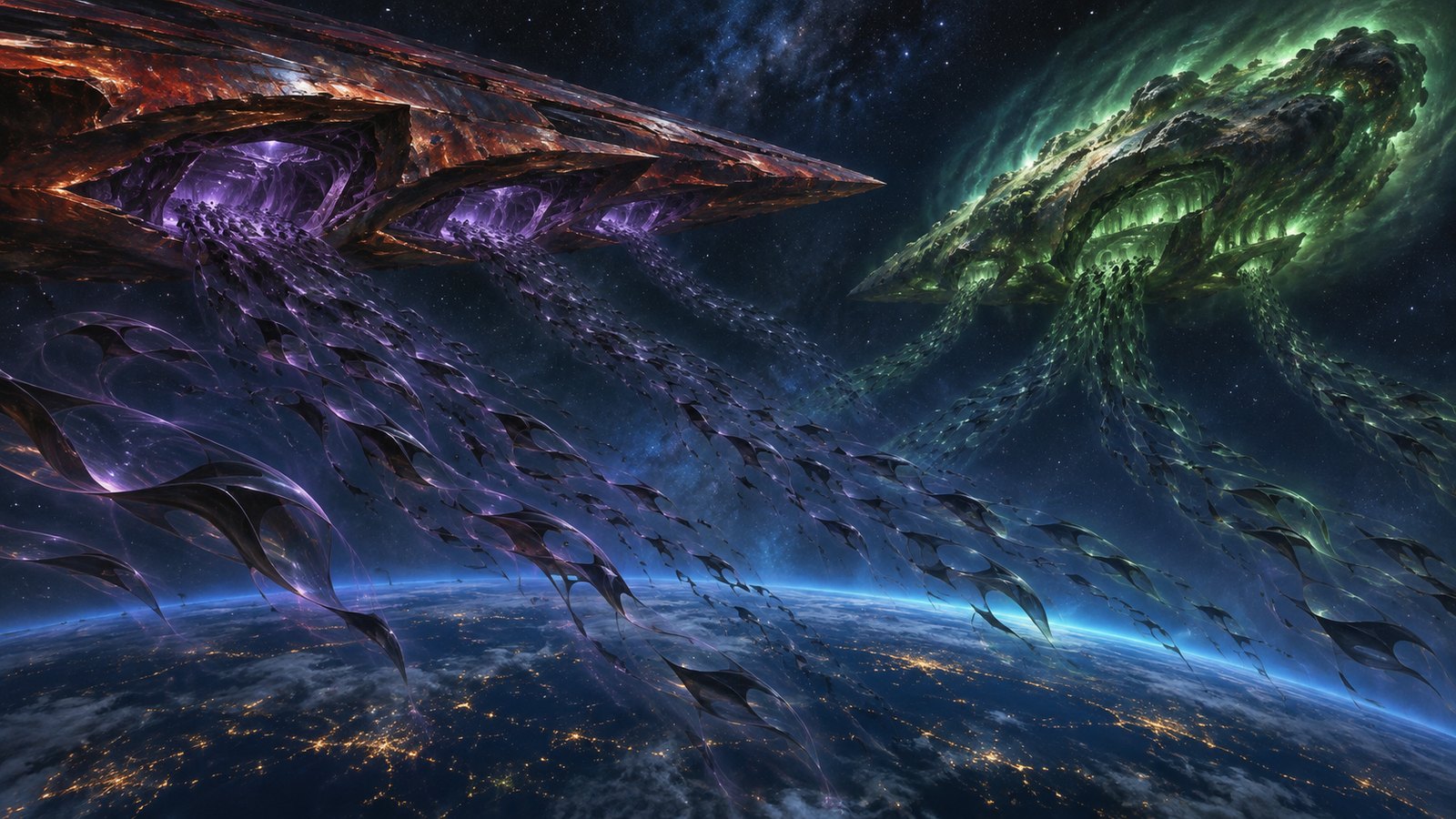
WORST CASE · A SCENARIO, NOT A FINDING
Everything above is on the record. What follows is what you get when you take the record and assume the worst.
Think about it the way an engineer would. If you wanted to reach a world, you would not send everything at once.
First, a messenger. Small, thin, quiet. It comes in close, swings around the star, and measures exactly how hard the sunlight pushes. It leaves without a tail, without a signal, without a word. Like the push nobody could explain.
Eight years later, the second ship. Big. Shrouded in a cloud of its own making, so every telescope sees a comet. It flies flat along the plane of the worlds, past Mars, around the Sun, toward Jupiter. Mapping the gravity of every planet on the way through.
Both through the same door. Lyra. Beside Vega.
Now look at where that door sits in the sky in winter. In December and January, Lyra slides into the evening twilight, about 58 degrees from the Sun, right at the edge of where the big survey telescopes stop looking.
Chelyabinsk came out of the glare and nobody saw it. ʻOumuamua was only found after it passed. If a third one is already on its way through that door, it will not be announced by a telescope.
It will be announced by a flash.
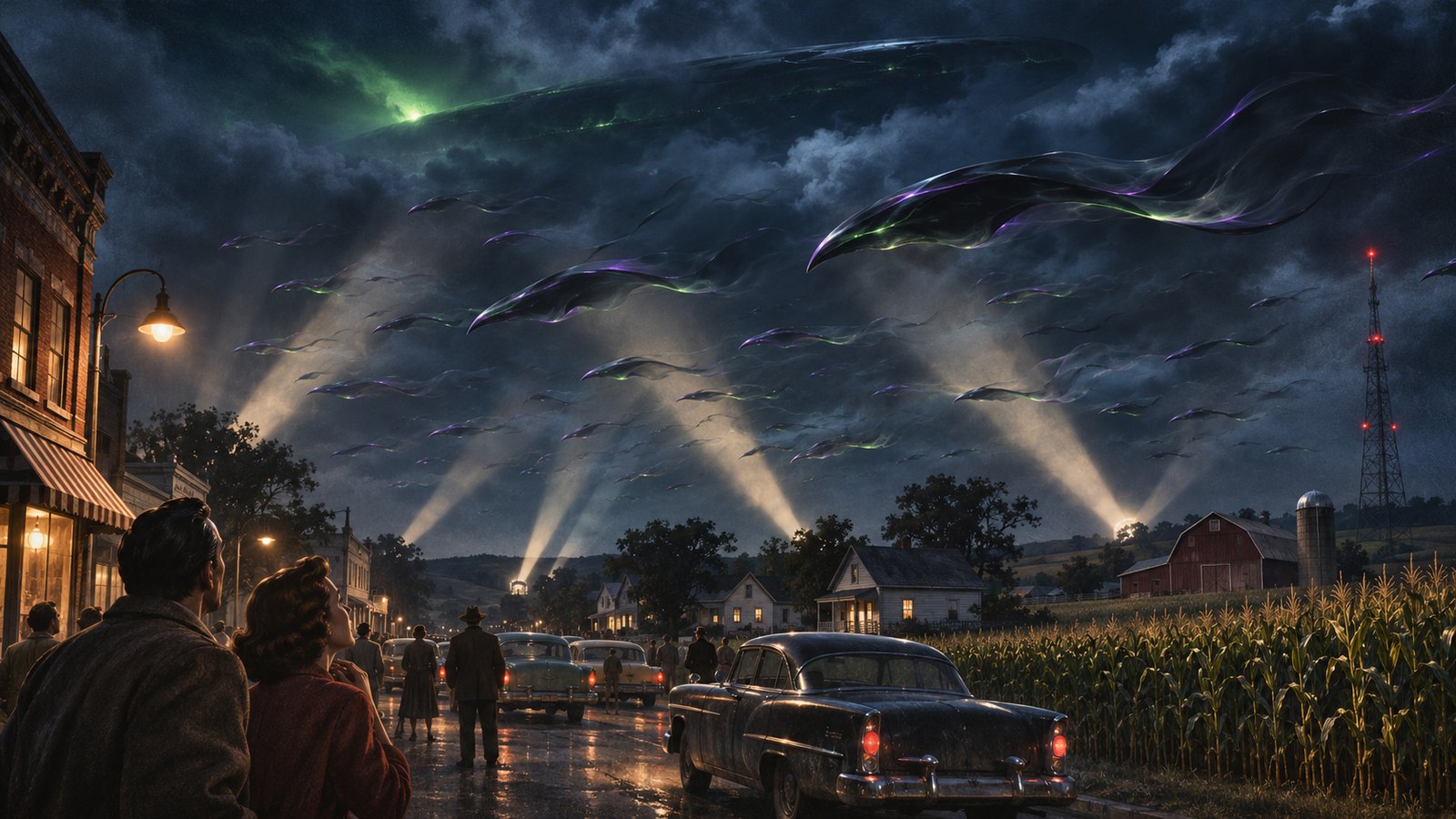
And in the worst case, it isn’t a rock at all. The scout measured the light. The carrier mapped the planets. The third one doesn’t need to hit anything. It only needs to open, high above the night side, and let the small dark things fall.
No heat rays. No tripods. Just silence, and then the dogs start barking all at once.
SUMMATION. Two interstellar visitors in eight years. Both entered from Lyra–Hercules, 14 degrees apart, inside a patch covering 1.7 percent of the sky. One accelerated with no tail and three explanations. One older than the Sun, with chemistry no comet should have, flying flat along the planets at odds of two in a thousand.
The Vera C. Rubin Observatory in Chile has now started sweeping the southern sky, and astronomers expect it to catch interstellar objects every year. Good. Somebody should be watching the door.
Until they are, open the Jedi Star Grid. Press Oort mode. Watch the two lines come in from the same place.
Then look up at Vega on the next clear night. If a third one comes through, nobody gets to call it a coincidence again.
Sources: Pan-STARRS / NASA (ʻOumuamua discovery, Oct 19, 2017); Meech et al., Nature 552, 378 (2017); Trilling et al., AJ 156, 261 (2018, Spitzer); Micheli et al., Nature 559, 223 (June 27, 2018); Bialy & Loeb, ApJL 868, L1 (2018); Seligman & Laughlin, ApJL 896, L8 (2020); Jackson & Desch, JGR Planets (2021); Bergner & Seligman, Nature 615, 610 (2023); ATLAS / IAU Minor Planet Center (3I/ATLAS discovery, July 1, 2025; CBET 5503); JPL Small-Body Database (orbits, speeds); Jewitt et al. (Hubble size limit, 2025); Cordiner et al. (JWST NIRSpec, Aug 6, 2025); Rahatgaonkar et al. (VLT nickel, 2025); Hibberd, Crowl & Loeb, arXiv:2507.12213 (July 2025); ESA (Mars orbiter observations, Oct 2025); Chelyabinsk: Popova et al., Science 342, 1069 (2013). Impact energy computed by STFN: 100 m, density 2,000 kg/m³, 60 km/s. The “Worst case” section is a scenario written for this article, not a finding. Illustrations are imagined science-fiction artwork. Interactive sky: the Jedi Star Grid, transhumangenocide.com.