DOGE fired the people who stop pandemics and agricultural catastrophes at the border. Three of 20 CDC port health stations now have zero staff. USDA APHIS lost over 1,600 employees. The New World Screwworm — eradicated in the 1970s — is back. This is not a metaphor.
The Department of Homeland Security exists, in theory, to protect the United States from threats. In early 2025, the Trump administration’s DOGE initiative began systematically eliminating the people who actually do that work — not the enforcement side, which received increased funding, but the inspection, health surveillance, and agricultural security apparatus that operates at ports of entry and screens what enters the country biologically.
The results are now measurable.
CDC PORT HEALTH: HALF THE STATIONS HAVE NO OFFICER IN CHARGE
The CDC operates 20 port health stations at major US airports and seaports. Their function: assess humans and animals arriving from abroad for disease threats, perform contact tracing on exposure events, and coordinate with local health authorities on infectious disease response. As of February 2025, 3 of those 20 stations had zero CDC staff. Half had no officer in charge.
DOGE ordered the CDC to cut over one-third of its contract spending by mid-April 2025. Approximately 2,400 CDC positions were terminated as part of the broader HHS workforce reduction — roughly 10,000 jobs eliminated across health agencies in a single wave. Port health stations, which operate at the precise interface between the outside world and domestic public health, were not exempted.
Senators Tom Cotton and Amy Klobuchar introduced the Biosecurity Modernization and Innovation Act of 2026 in direct response — a bipartisan bill acknowledging that the US lacks “clear, accountable oversight for biological risks.” When a Republican senator from Arkansas and a Democrat from Minnesota agree something is broken, it is broken.
USDA APHIS: 1,600 EMPLOYEES GONE
The USDA’s Animal and Plant Health Inspection Service is the agency that physically stops agricultural threats at the border — insects, plant diseases, animal pathogens, prohibited biological materials. In 2021, CBP agriculture specialists issued 73,917 emergency action notifications for restricted or prohibited plant and animal products, conducted 630,150 positive passenger inspections, and issued 7,190 civil penalties for undeclared prohibited agricultural items. That is what fully-staffed inspection capacity looks like.
After DOGE, APHIS lost more than 1,600 employees through resignations and forced separations. The National Sustainable Agriculture Coalition documented the agency scrambling to refill essential positions while simultaneously losing decades of institutional expertise. The people who know what an obscure Southeast Asian beetle looks like, or can identify a plant pathogen in a passenger’s luggage, do not get replaced in 90 days.
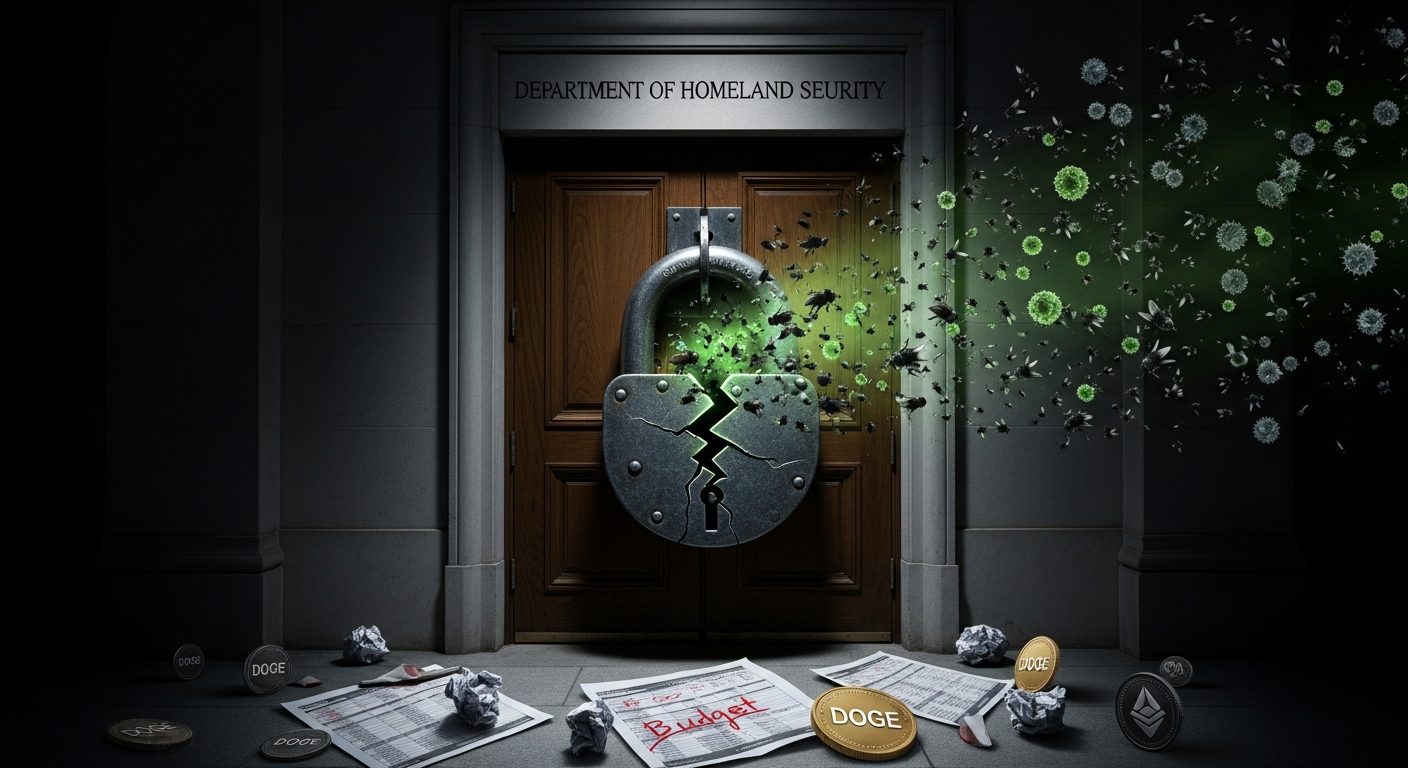
When the inspection system fails, the threats don’t wait for the budget to be restored
THE SCREWWORM IS BACK
The New World Screwworm — a parasitic fly whose larvae burrow into living tissue, killing livestock and capable of infecting humans — was eradicated from the United States and Mexico in the 1970s through a decades-long sterile insect technique program. It was one of the most successful agricultural eradication campaigns in history.
In December 2024, it re-emerged in Tamaulipas, Mexico — directly across the border from Texas. By May 2025, the USDA was forced to suspend all live animal imports through southern border ports of entry. When imports resumed in February 2026, only 4 of 11 cattle ports were operating, with enhanced inspection and quarantine requirements. The US announced a $100 million NWS Grand Challenge for sterile fly production and eradication.
The screwworm’s return does not have a single confirmed cause. What is documented: the inspection and surveillance infrastructure designed to catch exactly this kind of cross-border agricultural threat was being actively degraded at the same time the outbreak was developing.
THE STRUCTURAL PROBLEM
The DOGE approach to DHS applied a consistent logic: enforcement functions (ICE, CBP immigration) received increased funding and attention; everything else was treated as administrative overhead. This framing misunderstands what biosecurity actually is. Agricultural inspection, port health surveillance, and disease monitoring are not bureaucratic paper-pushing. They are the difference between a threat being caught at the border and a threat becoming endemic inside it.
A system that can be halted by a budget decision is not a security system — that much is true. But the correct response to that fragility is to make it more robust, not to accelerate the fragility by firing the people running it. The institutions are imperfect. The alternative to imperfect institutions is not no institutions. It is what is currently crossing the border unchecked.
The biological threats do not care about the fiscal year. The screwworm does not know there was a hiring freeze. The pathogen in a passenger’s bag does not wait for the port health officer to be rehired.
Sources: FedScoop / CNN Politics (DOGE DHS cuts, 2025); KFF Health News (CDC port health station staffing, Feb 2025); National Sustainable Agriculture Coalition (USDA APHIS staffing crisis, 2025); CBP Agriculture Enforcement Statistics (FY2021); USDA APHIS (New World Screwworm suspension, May 2025); CDC HAN Notice — New World Screwworm (2025); Congress.gov — Biosecurity Modernization and Innovation Act of 2026; Federation of American Scientists analysis (2026)