November 27, 2026 — From WP2Shell to the Cloud One Intrusion
A cybersecurity crisis that began with warnings over the integrity of WordPress websites in the early summer has reached one of the United States military’s most important cloud computing platforms, raising fundamental questions about the security of the digital infrastructure underpinning Western governments, intelligence agencies and private enterprise.
On Friday, Reuters reported that hackers had penetrated Cloud One, the United States Air Force’s flagship cloud computing platform, which incorporates infrastructure provided by Microsoft, Amazon, Google and Oracle. The intrusion was reportedly discovered during infrastructure upgrades, with attackers believed to have gained access to the platform’s administrative control plane through a software vulnerability. The extent of the damage remains unknown.
The reported breach is particularly alarming because Cloud One is not simply another government application. It is an environment responsible for hosting and administering military applications, including systems supporting air defense information, logistics and munitions management. Application migrations have reportedly been suspended, software updates restricted and certain administrative privileges revoked. U.S. Cyber Command has reportedly been brought in to assess the damage.
Unlike an intrusion into an individual website or database, a compromise of the administrative control plane potentially places the mechanisms responsible for managing, securing and restoring an entire computing environment within reach of an attacker. Depending on the privileges obtained, the implications could extend to authentication systems, software distribution, network configurations, sensitive data and the integrity of connected applications.
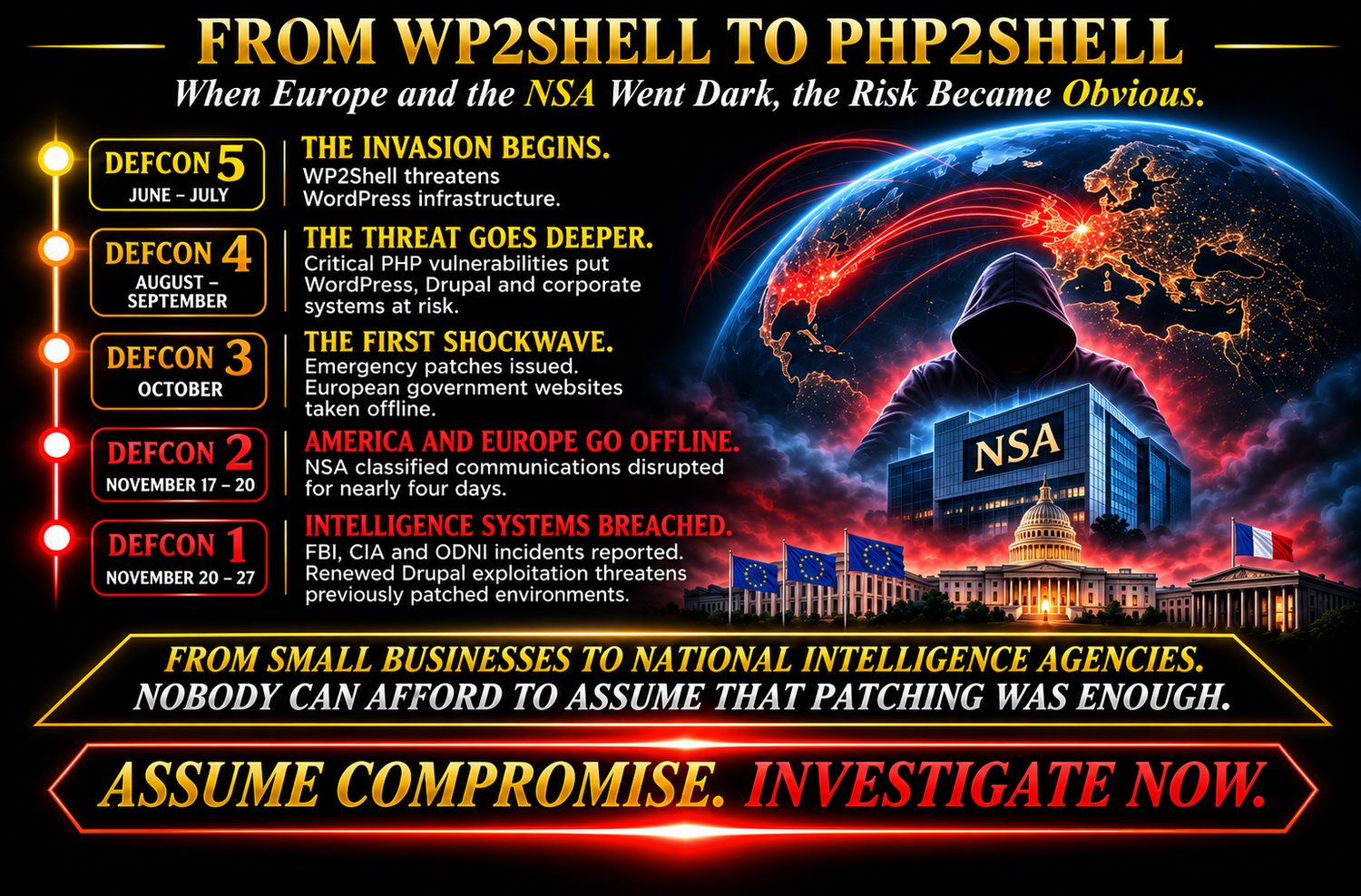
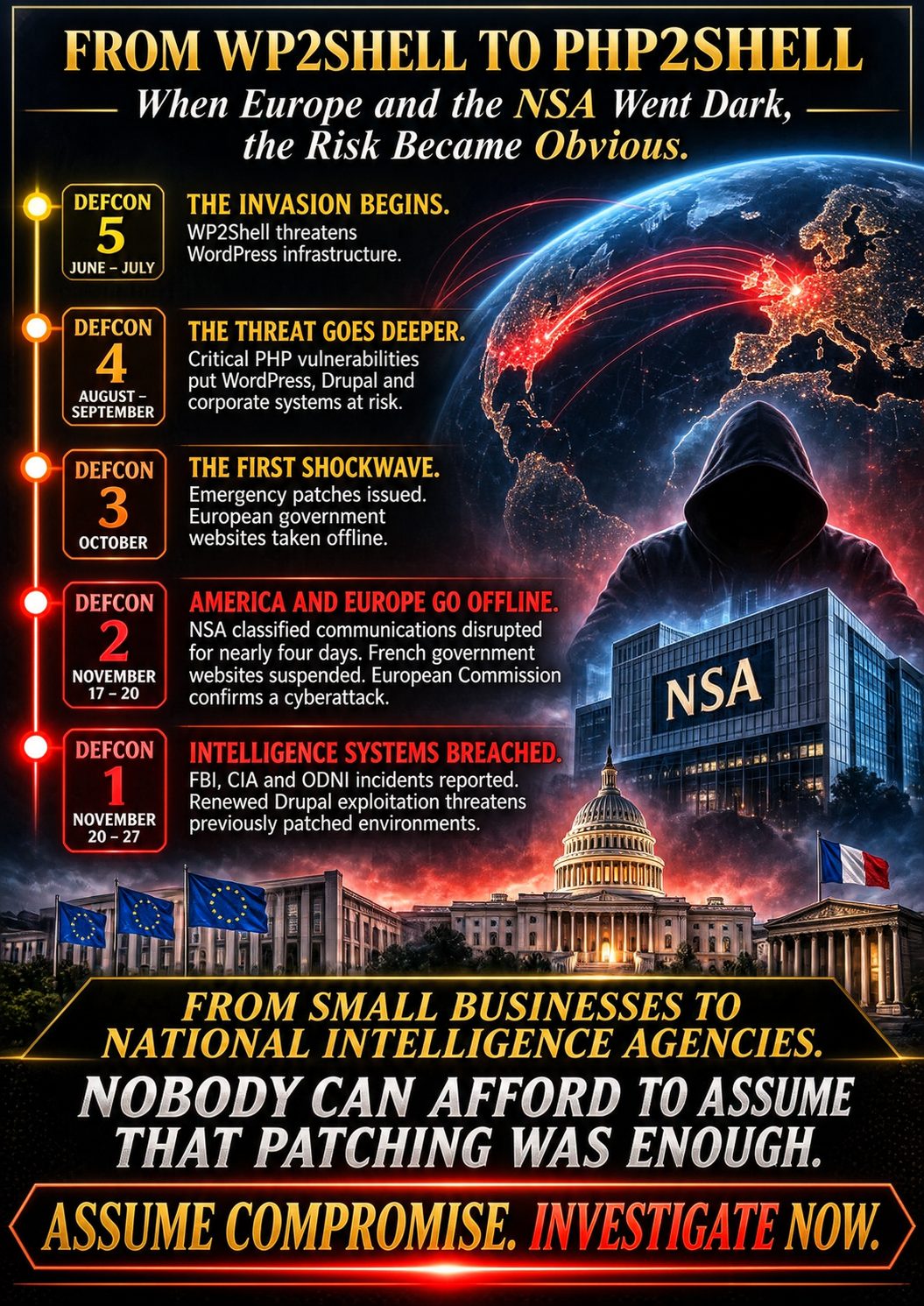
The disclosure comes at the end of an extraordinary six-month period of escalating cybersecurity incidents. In June and July, attention centered on vulnerabilities affecting widely deployed content management systems, including WordPress and Drupal. The emergence of WP2Shell and reports of active exploitation demonstrated how weaknesses in public-facing applications could provide unauthorized access to corporate infrastructure.
By August, researchers had identified critical vulnerabilities within PHP itself, the underlying programming language powering millions of websites and business applications worldwide. The findings expanded the scope of concern considerably. Organizations could no longer afford to concentrate exclusively on individual plugins, extensions or application-level security measures. The underlying runtime had become an attack surface in its own right.
The first major international shockwave arrived in October. Amazon Threat Intelligence detected an attempted exploitation of PHP2Shell on October 17, four days before the vulnerabilities were publicly disclosed and emergency patches became available. Government agencies, hospitals, educational institutions and corporations across Europe began taking websites and applications offline. Orange, the French telecommunications giant, temporarily suspended access to several services while implementing emergency security measures.
Yet it was during the third week of November that the scale of the crisis became increasingly apparent. On November 17, the National Security Agency’s classified internal communications network went offline, suffering disruptions that lasted nearly four days. During the same period, French government websites and public services experienced renewed interruptions, while the European Commission confronted a cyberattack affecting its institutional computing environment.
The near-simultaneous disruptions on both sides of the Atlantic marked a particularly disturbing moment. Institutions entrusted with national security, public administration and the protection of sensitive information were struggling to maintain the availability and integrity of their own digital infrastructure.
American officials attributed several of the outages to emergency security updates and infrastructure upgrades, rejecting suggestions that they constituted a single coordinated cyberattack. Nevertheless, the distinction between a confirmed intrusion and an emergency shutdown does not eliminate the broader concern: critical systems were being taken out of service as organizations confronted vulnerabilities capable of enabling unauthorized access.
What followed was a succession of disclosures involving some of the most sensitive institutions in the United States. The FBI began investigating an apparent intrusion into its National Crime Information Center, a database used by law enforcement agencies throughout the country. The Department of Agriculture faced a reported breach involving agricultural payment systems. Further reports emerged concerning unauthorized access to Treasury infrastructure.
On November 24, reports revealed that an unclassified intelligence system used by the Central Intelligence Agency had been breached, with the Office of the Director of National Intelligence also affected. Although officials indicated that classified information had not been exposed, the incident underscored the vulnerability of computing environments used by intelligence personnel to collect and analyze information.
Meanwhile, renewed exploitation of Drupal installations presented another troubling development. On November 25, the Drupal Security Team published a highly critical advisory warning that certain websites remained vulnerable to takeover despite an earlier security update. Perhaps most significantly, the advisory acknowledged that previously compromised websites might no longer appear to be in a vulnerable state.
That warning goes to the heart of the current cybersecurity dilemma. An organization can successfully install a security update, restore its website and resume normal business operations without necessarily eliminating an intrusion that occurred before the vulnerability was corrected.
Attackers who establish persistent access may leave behind unauthorized administrator accounts, compromised credentials, modified application files, web shells or concealed mechanisms capable of restoring access after conventional recovery procedures. A vulnerability scanner may subsequently report that the original weakness has been corrected while failing to establish whether the infrastructure itself remains compromised.
The Cloud One disclosure introduces an even more consequential dimension to this problem. If attackers obtain access to the administrative systems responsible for deploying software, managing identities and controlling infrastructure, the recovery mechanisms themselves must become subjects of investigation. Administrators can no longer automatically assume that the tools they rely upon to restore security remain trustworthy.
The involvement of infrastructure supplied by four of the world’s largest cloud providers illustrates the extraordinary concentration of modern computing dependencies. It does not establish that Microsoft, Amazon, Google or Oracle’s global platforms have been compromised. It does, however, demonstrate why the security of shared administrative environments has become a matter of strategic importance, extending well beyond the boundaries of any individual organization.
There is presently insufficient public forensic evidence to establish that the incidents reported between June and November originated from a single coordinated campaign, or that WP2Shell and PHP2Shell represent successive mutations of the same malicious software. Establishing those connections will require access to investigative findings that have not yet been made public.
But organizations need not wait for a definitive account of the entire crisis before reassessing their security posture. From small businesses operating WordPress websites to multinational corporations administering complex cloud environments, the fundamental engineering problem remains the same: closing a point of entry does not establish that an intruder has been removed.
For businesses that applied emergency PHP security updates without conducting an independent investigation, the priority should now extend beyond patch management. Application integrity, administrative credentials, internal network access, software dependencies, persistent processes, backups and deployment infrastructure all warrant examination where exposure is suspected.
The events of November have demonstrated the extent to which modern institutions depend on interconnected digital systems, and how rapidly security emergencies can disrupt even the most heavily defended organizations. The latest reports concerning Cloud One bring that reality directly into the realm of military cloud administration.
The defining question of this cybersecurity crisis is no longer whether an organization has installed the latest security updates. It is whether that organization can independently establish that its infrastructure, administrative systems and mechanisms of recovery remain under its own control.
A system can be operational without being secure. A vulnerability can be patched without an intrusion being eradicated. And an organization can return to business as usual without knowing whether an unauthorized presence remains inside its network.
The most dangerous assumption an organization can make today is that the absence of visible disruption is evidence of security.
Patched does not mean clean. Operational does not mean secure. Assume compromise. Verify integrity.
Need to know whether your systems are clean? Agentic Web Services investigates servers, websites and cloud environments: integrity checks, credential and admin-account audits, web-shell and persistence hunts, and hardening. See our cybersecurity page: agentic-web-services.com/cyber_security