The Trump administration spent $170 billion on mass deportation, cut border crossings to a 50-year low, and is on track to remove 500,000 people in 2025. The projected cost to the US economy: a 7% GDP reduction, 2.6 million fewer jobs, food prices up 10%. The numbers are not in dispute. The question is whether anyone is doing the math.
Border encounters in FY2025 reached 237,538 — an 84% drop from FY2024’s 1.5 million, the lowest figure since 1970. The administration’s enforcement machinery is working as designed. What is also working as designed: the removal of 1.2 million foreign-born workers from the US labor force between January and July 2025, a 6.5% decline in agricultural employment, and food price projections ranging from 1.5% to 9.1% depending on the final scale of deportations.
These are not opposition talking points. They are the outputs of Penn Wharton Budget Model, the Senate Joint Economic Committee, and the University of Texas macroeconomics department.
THE PROGRAM: SCALE AND COST
The “One Big Beautiful Bill,” signed July 2025, authorized $170.1 billion for the deportation program: $45 billion for detention centers, $29.9 billion for ICE enforcement operations, $46.6 billion for border wall construction. ICE detention population rose from 40,000 in January 2025 to 66,000 by December — a 75% increase — with 104 new facilities added. Planned capacity under the $45 billion build-out: 135,000 beds, triple the January 2025 level.
Cost per enforced deportation: $18,245. Cost per self-deportation via the CBP Home App incentive program: $2,600. The administration is spending seven times more per removal through enforcement than through voluntary departure. The Cato Institute calculated that deportations add nearly $1 trillion in additional costs to the bill beyond CBO estimates when lost tax revenue is factored in.
THE LABOR MATH
Undocumented workers represent 25% of all agricultural workers and 42% of crop farmworkers. More than 30% of plasterers, roofers, and painters in major construction trades are undocumented. Between March and July 2025, agricultural employment dropped by 155,000 workers. The food price increase projection of 10% assumes continuation at current pace — the higher-end model (8.3 million deported) projects 9.1%.
States with high undocumented worker concentrations saw employment drop 0.1% while the rest of the country grew 1.9% over the same period.
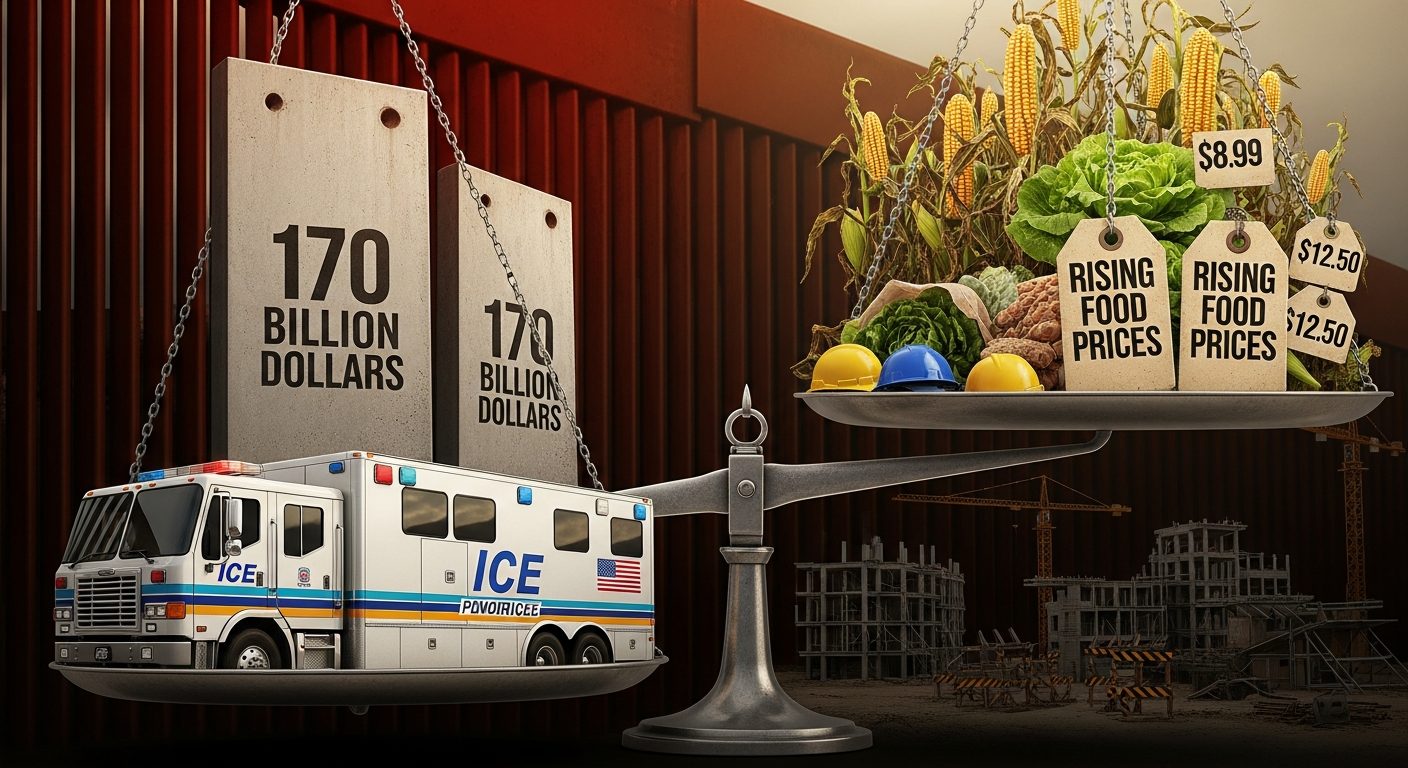
$170 billion spent. 1.2 million workers removed from the labor force. Food prices rising. The math doesn’t change based on who you voted for.
THE HUMAN COST
More people died in ICE custody in 2025 than in the previous four years combined. Francisco Gaspar Andres, a Guatemalan national, died of organ failure at Fort Bliss after being denied medical care on December 3, 2025. Geraldo Lunas Campos died in ICE custody; his death was ruled a homicide after an officer choked him. The UN’s Office of the High Commissioner for Human Rights documented 142,000 deportations between January 20 and April 29, with experts alarmed at deportations to El Salvador and third countries with documented torture records.
The US signed secretive deportation agreements with 64 countries. More than 30 are documented as having appalling human rights records. Eight thousand deportees were sent to countries other than their own. The UN issued formal warnings about US deportations to South Sudan.
THE DIPLOMATIC FALLOUT
Colombia’s President Gustavo Petro refused two US military deportation flights in January 2025, demanding “decent” treatment for deportees. Trump threatened tariffs, visa restrictions, and financial sanctions within hours. Brazil’s President Lula dispatched the Air Force to retrieve deportees from a Manaus stopover after objecting to migrants being handcuffed. Mexico restricted airspace access for military deportation flights. Venezuela initially refused flights before reversing under pressure.
ANALYSIS
The border crossing numbers are real. So are the detention numbers, the death toll, the labor data, and the economic projections. A policy can achieve its stated enforcement goals and simultaneously impose substantial costs on the economy that enforced it. Both things are true at the same time. The $170 billion program bought the lowest border crossing rate in 50 years and a 7% projected GDP reduction. Whether that is a good trade depends entirely on what you think the program is for.
Sources: DHS/CBP border encounter statistics (FY2025); Penn Wharton Budget Model (mass deportation fiscal effects, 2025); Senate Joint Economic Committee (mass deportation economic analysis); American Immigration Council (detention report 2026); OHCHR (deportation data, 2025); UN experts alarmed statement (2025); Civil Eats (agricultural labor impact, Aug 2025); Cato Institute ($1 trillion cost analysis); PolitiFact / NPR (deportation flights international incidents); NPR (asylum system changes, 2025)