The director of the CIA’s psychic warfare program was a Scientologist. Not a casual weekend-course Scientologist. Hal Puthoff reached OT VII — the highest Operating Thetan level available in 1971 — before the Agency put him in charge of remote viewing research at Stanford Research Institute. The two men he recruited to prove psychic spying worked for American intelligence were also Scientologists. The program ran for eighteen years and cost twenty million dollars. When it was shut down in 1995, the official finding was that remote viewing “never provided actionable intelligence.” But the men who built it had already been trained, by L. Ron Hubbard’s organization, to believe the human mind could leave the body at will, perceive across any distance, and manipulate matter, energy, space, and time. Nobody in Washington seemed to find that sequence unusual.
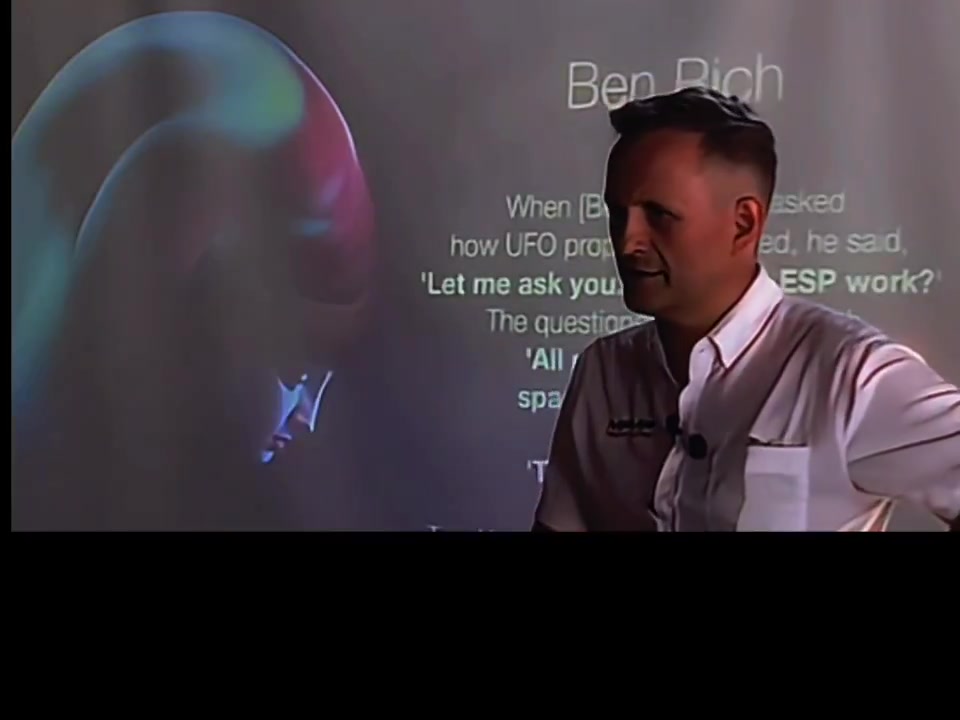
The video above presents a physicist demonstrating that the conscious human brain produces magnetic vortices and antivortices during cognitive tasks — measurable toroidal moments generated by the act of thinking itself. He then quotes Ben Rich, the long-time director of Lockheed Martin’s Skunkworks, who was asked how unidentified aerial objects achieve propulsion. Rich’s answer, relayed by the physicist, was disarmingly simple: he asked his questioner how extrasensory perception works. When the questioner answered that all points in time and space are connected, Rich said, “That’s how it works.” The physicist’s claim is that UFO propulsion is based on structures that produce toroidal moments — the same field geometry the brain generates when it thinks. And he argues that relic neutrino condensate, carrying embedded toroidal moments, pervades all of spacetime. If that sounds like science fiction dressed in physics, consider that the United States government spent two decades and eight figures investigating whether the first half of that claim — that consciousness can reach across space and time — was operationally real. They called it Stargate.
THE SCIENTOLOGY PIPELINE
The Stargate Project, which operated under various code names including SCANATE, Center Lane, Sun Streak, and finally Stargate from 1977 to 1995, was a Defense Intelligence Agency program headquartered at Fort Meade, Maryland. Its mission was to determine whether “remote viewing” — the claimed ability to perceive distant locations using nothing but the mind — could produce military intelligence. The program was directed by Hal Puthoff, a Stanford-trained physicist who had previously worked for the Naval Security Group and the National Security Agency. Puthoff’s physics credentials were genuine. But what the program’s institutional history consistently downplays is where Puthoff learned to take psychic phenomena seriously in the first place. He joined the Church of Scientology in the late 1960s and by 1971 had reached OT VII, the highest Operating Thetan level then available. In 1974, he wrote in Scientology’s Celebrity magazine that the organization had given him “a feeling of absolute fearlessness.” The OT levels, according to Scientology’s own doctrine, are designed to restore the thetan’s native abilities: perception without physical senses, exteriorization from the body, and eventually control over matter, energy, space, and time. Puthoff brought those exact claims into a laboratory funded by the Central Intelligence Agency.
The man Puthoff chose to prove remote viewing was real was Ingo Swann, who had reached Operating Thetan status through Scientology auditing before approaching Stanford Research Institute in 1972. Swann is credited with coining the term “remote viewing” and developing the Coordinate Remote Viewing protocol — the method where a psychic is given nothing but a set of geographic coordinates and asked to describe what exists at that location. The American Society for Psychical Research reportedly attempted to expel Swann in April 1972 specifically because of his Scientology affiliation. It was not an incidental detail. Swann himself attributed his psychic development to the OT levels, which Scientology’s own literature describes as extending one’s abilities to include “controlled out-of-body experiences.” A second key remote viewer in the program, Pat Price, a former Burbank police commissioner, was also a Scientologist. Price produced sketches of Soviet military facilities at Semipalatinsk that CIA officers said “appeared to conform to CIA intelligence photographs.” Three of the program’s foundational psychics were products of the same training system, developed by the same organization, founded by a man who had performed sex magick rituals with a disciple of Aleister Crowley less than two years before publishing Dianetics.
THE CROWLEY THREAD
L. Ron Hubbard’s pre-Scientology biography contains a fact that the Church has spent decades trying to reframe: in 1945, Hubbard moved into the Pasadena mansion of Jack Parsons, a founding member of NASA’s Jet Propulsion Laboratory and a devoted practitioner of Aleister Crowley’s Thelema. Together they conducted the Babalon Working — a series of ritual operations designed to summon a supernatural entity into physical manifestation. Hubbard’s role, according to documented accounts, involved channeling messages attributed to Babalon and speaking in what Parsons described as the goddess’s voice. The Church of Scientology later claimed Hubbard was conducting an undercover operation to break up a “black magic ring.” But in his 1952 Philadelphia lectures — recorded, transcribed, and sold by the Church itself — Hubbard explicitly connects Scientology’s practices to “the magickal practices of Aleister Crowley.” Crowley’s system, rooted in the Hermetic Order of the Golden Dawn and the OTO, was itself a structured technology for expanding consciousness, perceiving non-physical realities, and exerting will over material circumstances. Hubbard took that architecture, stripped the robes and candles, replaced ritual with auditing sessions and an E-meter, and sold it as self-improvement. The destination was the same: a human being operating outside the constraints of ordinary perception. The Operating Thetan levels are Crowley’s Great Work with a franchise model.
This is not guilt by association. It is means, motive, and lineage. Crowley’s system claimed that trained human consciousness could perceive across distance and time. Hubbard operationalized that claim into a graded curriculum. Three graduates of that curriculum became the foundational test subjects for a twenty-million-dollar American intelligence program investigating whether human consciousness could perceive across distance and time. The question is not whether Scientology is a legitimate religion. The question is whether the United States government used a privatized occult training pipeline to source psychic operatives for classified defense programs — and whether that pipeline traces, through documented links, back to the same Western esoteric tradition that produced Crowley, the Golden Dawn, and the entire apparatus of ceremonial magick that has operated in parallel with institutional science since the nineteenth century.
MONTAUK, LOOKING GLASS, AND THE DELTA T WAVE
The Stargate archive is declassified. The connections above are documented. What follows is where the documented record ends and the testimony begins — but the testimony comes from people who were inside the machine. The Montauk Project, allegedly conducted at Camp Hero on the eastern tip of Long Island, New York, is described by its claimants as an extension of the same research lineage: consciousness-based technology developed under military auspices, using equipment that could amplify psychic output the way an antenna amplifies radio. The central claim — that a device called the Montauk Chair could lock onto a subject’s psychic field, amplify it through a Delta T antenna, and project consciousness forward or backward in time — sounds like fiction. Preston Nichols and Al Bielek, who published the primary accounts beginning in the early 1980s, openly acknowledged the material could be read as science fiction. But the underlying physics question is the same one the video above presents: does consciousness generate a measurable field, and can that field be technologically amplified? The physicist in the video has just shown you that the answer to the first question is yes. The brain produces magnetic vortices and antivortices — toroidal moments — during the act of thinking. The Montauk claim is that the military discovered this decades earlier, called the signature the Delta T wave, and built hardware to exploit it.
Project Looking Glass, reported through whistleblower testimony attributed to personnel at Area 51 and the Nellis complex, allegedly involved technology that could display probable future timelines — not time travel in the Hollywood sense, but a kind of temporal remote viewing achieved through technological amplification of the same consciousness-based field effects that Stargate’s psychics were producing unaided. The name itself is telling. The CIA’s remote viewing program began as Project SCANATE in 1970, was renamed Center Lane, then Sun Streak, then Stargate. Each name change followed a security breach or an institutional reorganization. The pattern — rename, reclassify, continue — is standard operating procedure for programs the intelligence community wants to keep running after public exposure. The official narrative is that Stargate was terminated in 1995 after the American Institutes for Research concluded it produced no actionable intelligence. But the AIR review was commissioned by the CIA after the program was transferred from DIA control — a transfer that itself looks less like an audit and more like a hostile takeover. The three full-time psychics working the program at shutdown were operating on a five-hundred-thousand-dollar annual budget. That is not the budget of a program anyone took seriously. It is the budget of a program that had already been moved somewhere else.
THE DOG THAT DIDN’T BARK
Major General Albert Stubblebine, commanding general of the U.S. Army Intelligence and Security Command, required his battalion commanders to practice bending spoons with their minds. Lieutenant General James Clapper, who later became Director of National Intelligence under President Obama, was a project leader for Stargate in the 1990s. These are not fringe figures. Stubblebine commanded INSCOM. Clapper ran the entire American intelligence community. If the research was genuinely worthless, these are not the careers you would expect to find attached to it. The program produced claimed hits including the 1976 location of a downed Soviet spy plane by psychic Rosemary Smith, the identification of a Soviet nuclear submarine in 1979, and the detection of plutonium in North Korea in 1994. The official position is that none of these constituted actionable intelligence. But the program kept its funding for eighteen years, across multiple administrations, surviving every budget review and reorganization. Programs that produce nothing do not survive eighteen years inside the American defense establishment. Programs that produce something embarrassing do.
Ben Rich told a questioner that UFO propulsion works the same way extrasensory perception works — because all points in time and space are connected. The physicist in the video demonstrates that conscious thought produces toroidal magnetic fields. Scientology’s founder learned consciousness-expansion techniques from a lineage traceable to Aleister Crowley, built a graded training system around them, and three products of that system became the experimental core of a two-decade CIA psychic warfare program. The Montauk and Looking Glass claims — that the military built hardware to amplify and direct the same field effects those psychics were generating organically — remain unverified. But the verified portion of the story is strange enough. The United States government spent twenty million dollars testing whether Scientology’s promises about the Operating Thetan were real. The program that tested them was directed by a man who had reached OT VII. And when it was shut down, the official finding was not that psychic perception is impossible. The finding was that it “never provided actionable intelligence.” That is a statement about operational utility, not about whether it works. The dog did not bark. The absence is the evidence.
Source: STRANGER THAN FICTION NEWS