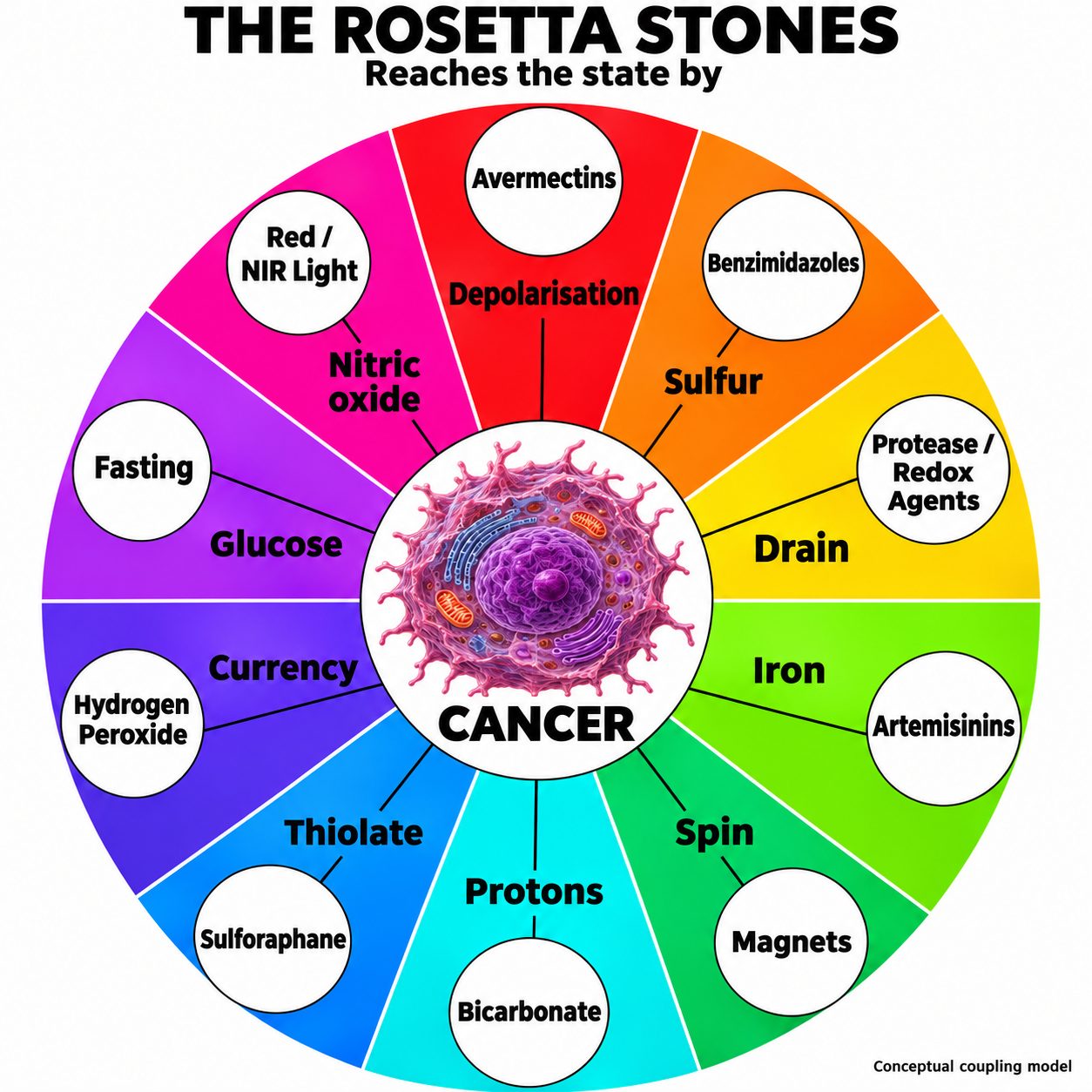
Ten things that have nothing to do with each other all push cancer the same direction. A dog wormer. A malaria pill. A gold tablet for arthritis. A magnet. Baking soda. Broccoli. Peroxide. An empty stomach. A red light. In our model they are not ten treatments. They are ten handles on one switch, and this is the article where we show you the switch.
We solved the mystery in the last piece. This one is the engineering drawing.
Start with the thing that should bother you. Fen ben is a dog wormer. Ivermectin is a wormer too. Artemisinin is for malaria. Auranofin is a gold salt they gave arthritis patients in the eighties. Sulforaphane is the stuff in broccoli sprouts. Sodium bicarbonate is baking soda. Hydrogen peroxide is the brown bottle under your sink. Then there is a magnet, a missed meal and a wavelength of red light, which are not even chemicals.
In normal drug science that list is impossible.
Drugs are supposed to work like a key in a lock. A molecule has a particular shape, that shape fits one particular protein, and something happens. Change the shape, lose the effect. That is the whole model, and it is why pharmaceutical companies spend a billion dollars filing the teeth on a key.
Ten keys with completely different shapes cannot open the same lock. So either we are looking at ten unrelated coincidences stacked one on top of another, or the lock-and-key story is not what is happening here.
Our position is the second one. They are not keys. They are all turning the same dial.
Every cell you own is running a lightning bolt
Here is the fact that reorganises everything, and it is ordinary textbook biology.
Every cell in your body holds a voltage across its outer skin. About 70 millivolts. That sounds like nothing, about a twentieth of a watch battery.
But voltage on its own means nothing. What matters is voltage divided by distance, and that skin is five nanometres thick. Five billionths of a metre. Do the division and you get a hundred and forty thousand volts per centimetre.
That is lightning-strength field, folded into a space smaller than a virus, in every one of the thirty trillion cells you are made of, right now, while you read this.
Put a AA battery across a gap a millionth the width of a hair and you would have something that tears atoms apart. That is what your cell membrane is. We are not describing an exotic state of matter here. We are describing Tuesday.
The messenger is bleach
Cells talk to themselves with hydrogen peroxide. The same molecule as the brown bottle, in tiny amounts, used deliberately.
It is a strange messenger, and the strangeness is the point. It has no receptor. It binds to nothing. There is no peroxide-shaped hole it slots into. It simply arrives and the cell behaves differently.
How does a cell read a message from a molecule that does not bind anything? With sulfur.
Scattered through your proteins are sulfur atoms, sitting on an amino acid called cysteine, and they work like switches. Peroxide flips them. That is the telegraph. Peroxide is the signal, sulfur switches are the receiver, and that is how a molecule with no shape tells a cell what to do.
And one more piece, which is the piece almost everybody skips. A sulfur switch can only be flipped when it is in its charged form, and whether it is sitting in that form depends on how acidic the neighbourhood is. Acidity does not change the message. It decides who can hear it. It is the volume knob.
So: voltage is the power supply, peroxide is the money, sulfur switches are the till, and acidity sets the exchange rate. Hold those four and the rest of this article is downhill.
The loop nobody drew for you
You were taught the Krebs cycle at school. A ring of eight steps, each one feeding the next, with a helper molecule that has to be recycled or the whole wheel stops turning. You were made to memorise it.
There is a second loop running alongside it that you were never shown, and in our model it is the one that matters. It goes like this.
The cell’s voltage drives electrons through the power plant in the mitochondria. A few of them slip out early and land on oxygen, and that makes the raw material. An enzyme converts that raw material into hydrogen peroxide, and the money has been minted. The peroxide drifts off and finds a sulfur switch, but only the switches in the right charged state can take the message, which is where acidity decides the volume. The switch flips. Then it locks, by pairing up with a second sulfur nearby, and now the cell is holding a memory rather than just receiving a pulse.
And then the cell has to put everything back. There is a reset crew that unlocks the switches and returns them to the starting position, and that crew runs on a rechargeable battery. That battery is recharged with sugar.
Then round it goes again, because the switches that flipped changed which genes are running, and that changes how leaky the power plant is, which changes how much peroxide gets minted next time.
That is the wheel. Voltage at the top, peroxide minted, switches flipped, switches locked, reset crew, sugar to pay the reset crew, back to the top.
There is also a cliff. If peroxide keeps arriving while the reset crew is blocked, the switch does not just stay flipped. It burns out. Permanently. That is the edge this whole system runs along, and in our model it is the edge every single one of the ten agents walks a cancer cell towards.
Now watch where the ten things land
This is where it stops being a coincidence and starts being a machine, so take it slowly.
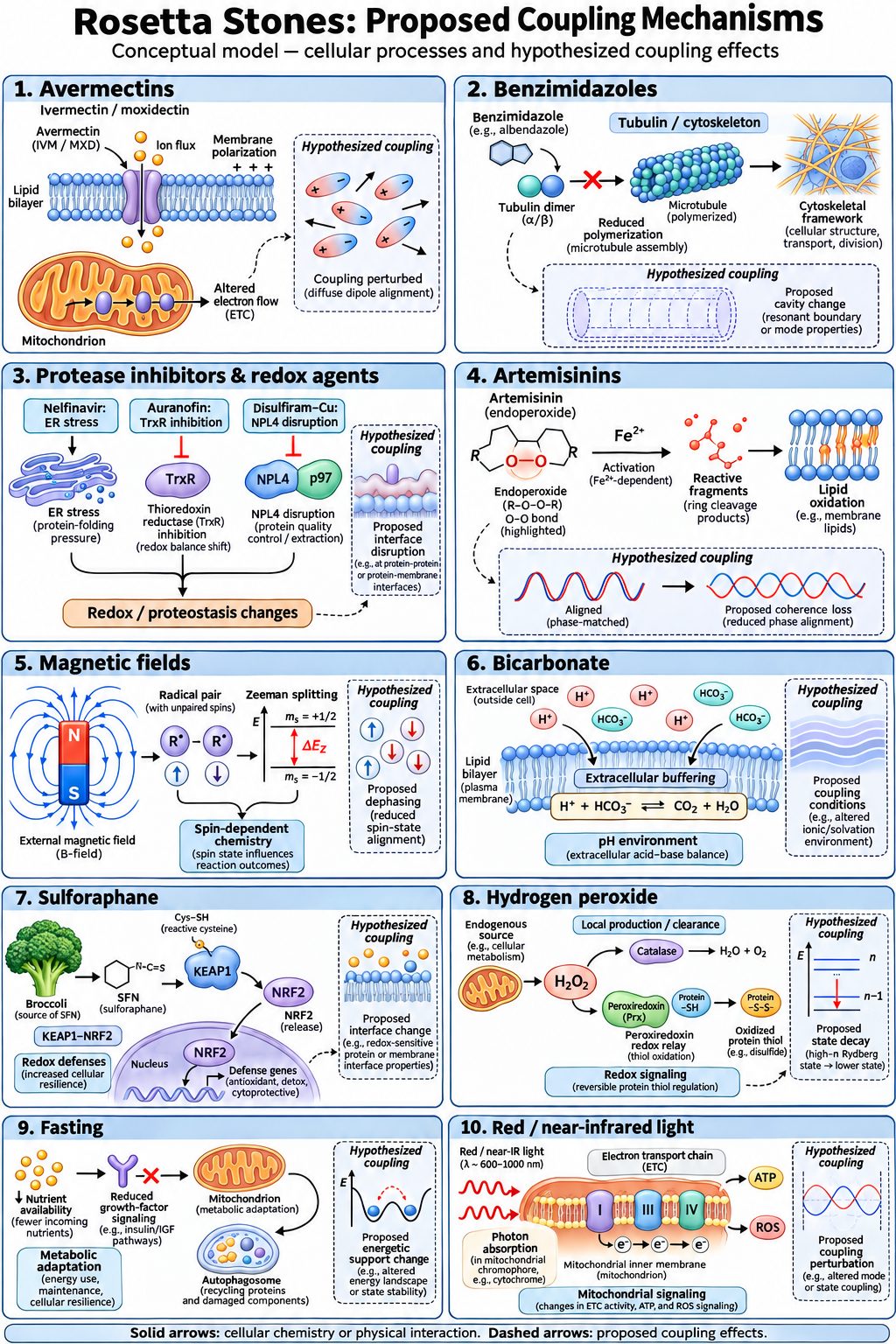
Ivermectin and moxidectin go after the voltage. They open a channel in the membrane and let the charge bleed out. They are working at the power supply.
Red light works there too. Your mitochondria have a brake pedal held down by a molecule called nitric oxide, and red light knocks it off. Electron flow changes. Same station, opposite direction.
Magnets work one step along, at the leak. This sounds like the daftest item on the list until you learn that magnetic fields genuinely alter chemical reactions that run through paired electrons, which is published, replicated, unglamorous physics. The magnet changes how much of the raw material turns into peroxide. No molecule involved at any point.
Artemisinin, the malaria drug, mints peroxide directly. It carries a peroxide bridge inside itself and hands it to iron, and cancer cells are greedy for iron.
Fen ben mints it too, through the sulfur it carries. We will come back to fen ben, because fen ben is the whole argument.
Nelfinavir, the old HIV drug, mints it as a side effect of jamming the cell’s protein folding line.
Hydrogen peroxide does not need an intermediary. It is the money.
Baking soda turns the volume knob. It makes the neighbourhood less acidic, so more switches can hear.
Broccoli skips the messenger entirely and writes straight onto the switches. Sulforaphane grabs the sulfur directly.
Auranofin, the gold arthritis tablet, and disulfiram, the old alcoholism drug, both take out the reset crew. The switches flip and stay flipped. That is the cliff.
Fasting works at the bottom of the loop. The reset crew runs on sugar. Stop sending sugar and the crew cannot be paid.
Count them. Four mint the money. Two block the reset. One starves the payroll. Two change the power supply. One turns the volume up. One writes straight on the switches.
Not one of them is doing the same chemistry as any other. They enter at six different places. And that is exactly the point, because a loop has a property that a lock does not: jam any station and the whole wheel stops. You do not need the same key. You need the same wheel.
That is our answer to the impossible list. Ten things with nothing in common, one effect, no coincidence required.
Fen ben settles it
Everything above is a story until something can be tested, so here is the test, and it is cheap enough that a decent lab could run it next week.
Fen ben does two separate things.
It breaks the cell’s internal scaffolding. That is how it kills worms, and that is the one thing every oncologist who has heard of it will tell you is responsible.
It also carries sulfur, which feeds the peroxide loop.
Two legs. The whole field credits the first leg. We say the second leg is doing work nobody has counted.
And the wormer family splits perfectly down that line, which is the gift. Fen ben has sulfur. Oxfendazole has sulfur. Albendazole has sulfur. Mebendazole does not. Flubendazole does not.
Every one of those five breaks the scaffolding. That is what makes them wormers in the first place. The scaffolding leg is identical across the family. The only thing that changes from one to the next is whether there is a sulfur atom hanging off the side.
So line all five up in one experiment and see how they sort.
If the scaffolding story is the whole story, sulfur is decoration and all five should land in a heap. If they sort by sulfur instead, then the explanation medicine has been using for this family is missing a leg, and it is missing the leg that matters.
We will say in advance what we expect, because a prediction made afterwards is not a prediction. Fen ben and oxfendazole out in front, albendazole behind them, mebendazole and flubendazole trailing.
And if they all land in a heap, we are wrong, and we will have said so before the data came in.
There is a precedent for this exact result, which is why we are confident. Take artemisinin and remove one single oxygen atom from its peroxide bridge. Same molecule otherwise, same shape, same everything. It stops working. One atom. That is not a subtle effect, and it tells you the peroxide leg was carrying the load the whole time.
The part most people will not follow us on
Everything to here is chemistry you can look up.
Here is where we go further, and we are flagging the step rather than smuggling it.
That lightning-strength field across the membrane is not just powering the loop. It is a boundary. Fragile, highly excited forms of matter cannot survive inside a field that strong, and the arithmetic on that is not close: the field is roughly two and a half thousand times what it takes to tear such a thing apart.
So anything like that cannot be inside the membrane. If it exists in biology at all, it has to sit outside, in the body of the cell, away from the skin. And since the membrane’s voltage is what sets that fence, moving the voltage moves the fence.
Now look at what is sitting in exactly that region. The cell’s scaffolding, the same scaffolding fen ben takes apart, is built from a protein where every single unit is a tiny electrical bar magnet, and they are stacked in perfect register, thousands of them, all facing the same way. It is an antenna array, in the one place our own arithmetic said anything like this could survive. We did not go looking for that. The number picked the address and the scaffolding was already living there.
Which gives fen ben a second job. It is not only breaking a spindle to stop a cell dividing. In our model it is pulling down the aerial.
And it makes fen ben the only item on the whole list that reaches both legs with one molecule. Mebendazole takes the aerial down and feeds nothing. Auranofin feeds the loop and leaves the aerial standing. Fen ben does both, which is our explanation for why fen ben, out of all of them, is the one carrying the deepest trail of human stories behind it. Not popularity. Chemistry.
What we are actually claiming
Every cell runs a lightning-strength electrical field. That field powers a loop that mints a chemical messenger, writes it onto sulfur switches, and has to buy the eraser with sugar. Ten unrelated things all jam a different station of that one loop, which is why ten things with no shared shape produce one shared effect.
And the field that powers the loop also draws a boundary, and in our model there is something living against that boundary.
The chemistry stands on its own. The boundary is ours, and we have put up the experiments that would knock it down.
We have published the compounds. We have published the structures, ninety-eight of them, into the public domain where no company can fence them. Now we have published the mechanism, which is the part that tells you what to test next and in what order.
The cheapest experiment on the list is five wormers, one assay, sorted two ways. Somebody with a lab and an afternoon can take the first real swing at this.
This is a research model and a prosecution brief, not a prescription. Anything here belongs alongside your treatment and your doctor, never instead of them.
Part two of THE MYSTERY OF CANCER HAS BEEN SOLVED, which carries the full structure list — all ninety-eight, with their machine-readable formulas, dedicated to the public domain.