STFN Field Intelligence Division — Round 1, the case for the prosecution. Trajectories, telescopes and lab physics are cited as fact; the torpedo model is our assessment, and it is labelled as ours.
The first one came out of Vega. That is not our theory. That is the trajectory. In October 2017 an object up to a quarter of a mile long fell in from the direction of the brightest star in Lyra, whipped around our Sun, and left speeding up with nothing visible pushing it. Eight years later a third one arrived, older than our Sun, carrying water no comet of ours has ever carried, and it came close to Mars in the same week NASA went dark. Nobody in an official chair has said the word torpedo. We will.
Since October 2025 this newsroom has kept a file on these visitors, and the file has only grown heavier. Our Trojan Comet reports laid out how 3I/ATLAS slid into the inner solar system under a name chosen to bore you. Our 84-minute imaging session entered an amateur astronomer’s footage of the object shedding as it passed Mars. Our Top Secret report documented NASA’s public feeds going silent at the exact moment of the Mars encounter. And our Lyra-Hercules report pointed at the patch of northern sky where this traffic began. Four reports, one direction, one question nobody official will touch: who is sending them?
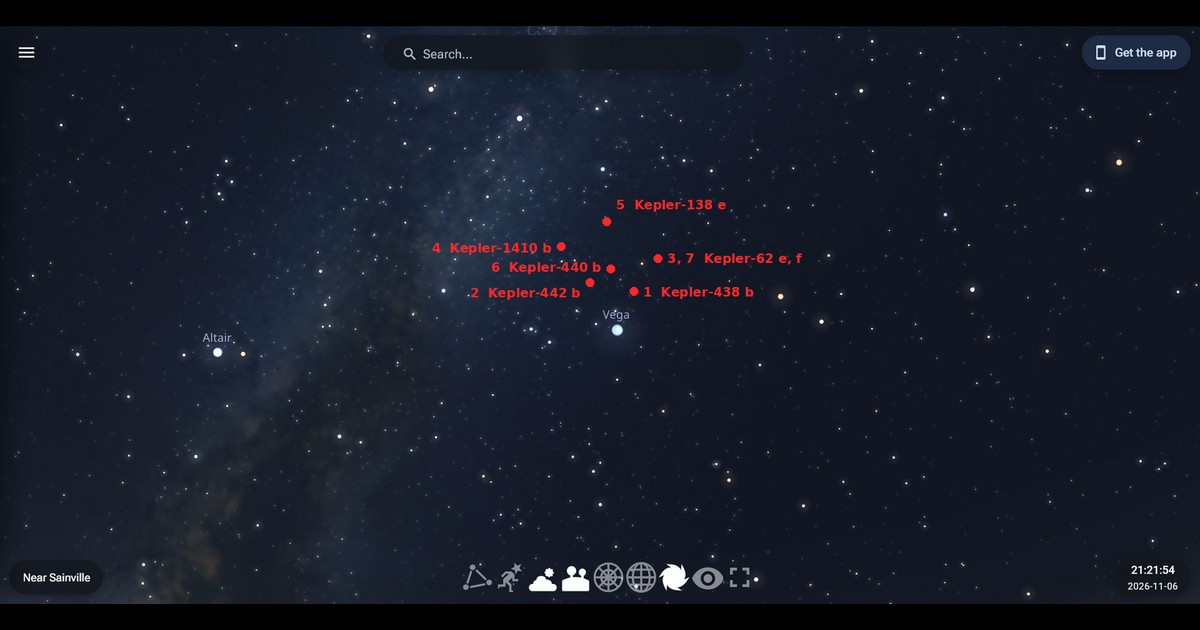
Tonight the corridor gets a return address. The map at the top of this page is a real sky, photographed the evening of November 6, 2026, with Vega blazing at its centre. Every red dot on it is a confirmed planet in its star’s Goldilocks zone, pulled from NASA’s own exoplanet archive and plotted to within half a pixel. They sit in a tight knot just above Vega, in the same small window of sky the first interstellar visitor fell out of. Our assessment is that this is not a coincidence of geometry. It is a neighbourhood, and it is the neighbourhood that is shooting at us.
We call them dark matter torpedoes, and the name is chosen with care. Dark matter makes up roughly 85 percent of all the matter in the universe, and no instrument humanity has ever built has seen a single particle of it; we know it is there only by what it does to everything around it. In our model the weapon is built to the same standard. It carries no warhead a radar can paint, no engine a thermal camera can catch, and no transmitter a radio dish can hear. You find it the way physicists find dark matter: by the damage. And the damage, as you will see, has a physics with a name.
EXHIBIT A: THE FIRST ONE CAME OUT OF VEGA
On October 19, 2017, the Pan-STARRS 1 telescope on Haleakala, Hawaii, caught something no human had ever recorded: an object that did not belong to our Sun. It had already made its closest pass, swinging inside the orbit of Mercury on September 9 at about 0.25 astronomical units, and it was leaving at nearly 315,000 kilometres an hour. When astronomers ran its path backwards, the line pointed to the constellation Lyra, to within a few degrees of Vega. The first confirmed interstellar object in recorded history did not come from some random corner of the galaxy. It came from the star on our map.
Then the object misbehaved. It showed no coma, no tail, no gas, nothing a comet is supposed to show, and its light flickered in a way that told astronomers it was long and thin, as much as ten times longer than it was wide, tumbling end over end. In June 2018 a team led by Marco Micheli reported in Nature that it was accelerating away from the Sun faster than gravity allowed. Something was pushing it, and the telescopes could not see what. Months later the chair of Harvard’s astronomy department, Avi Loeb, co-wrote a paper asking in print whether it could be an artificial light sail. That is where the mainstream record leaves it: an unexplained shove, from an unseen source, on an object that came out of Vega’s quarter of the sky.
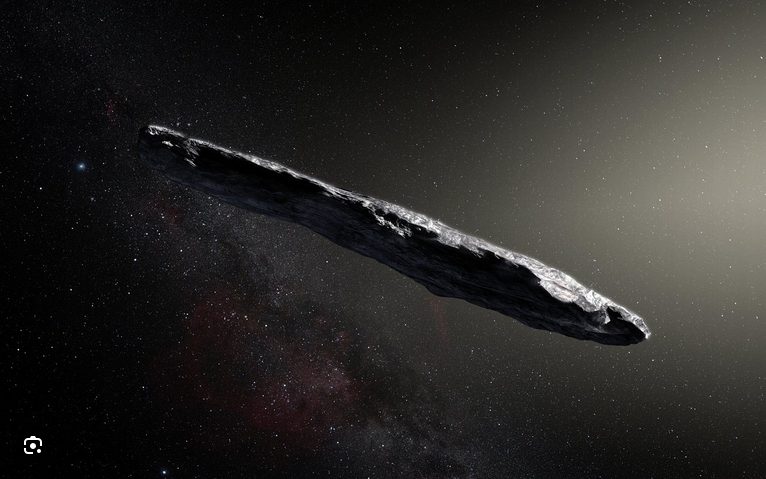
And here is the detail that will not sit still. The astronomers who found it chose a Hawaiian name, ʻOumuamua, which the discovery team translated as a messenger from afar arriving first. Arriving first. Not a rock. Not debris. A messenger, and the first of something. You do not call a thing the first unless you expect a second, and the sky obliged: a second visitor in 2019, a third in 2025, after all of recorded history had produced none at all. Scouts are not sent by accident. They are sent ahead of something.
The second messenger arrived on schedule. On August 30, 2019, the amateur astronomer Gennadiy Borisov, working from his own observatory in Crimea, spotted 2I/Borisov falling in from interstellar space at about 32 kilometres a second. Unlike its predecessor it wore a coma and a tail like a textbook comet, and the mainstream exhaled: see, just a comet. In our model that was the point. The second shot was a calibration round, a conventional-looking body sent to learn how our telescopes respond, what we notice, and how fast we report it. Six years later the heavy one came.

EXHIBIT B: THE YARD AND THE HOUSES
Vega sits just 25 light-years from Earth, one of our nearest bright neighbours, and it has been under watch longer than any star of its kind. In 1983 NASA’s IRAS satellite found it wrapped in a vast disk of dust, the first ever seen around another star. In 2024 Hubble and the James Webb Space Telescope turned on it together and found something they could not explain: a disk roughly 100 billion miles across that is, in the words of the University of Arizona team, ridiculously smooth. No clumps. No lanes. No gaps carved by giant planets. Their data rule out any world bigger than Neptune on a wide orbit. In our assessment that is not an empty system. That is a swept yard. Nature leaves rubble. Somebody keeps that yard clean.
Look past the yard and you find the houses. NASA’s Kepler space telescope spent four years staring at one patch of sky in Lyra and Cygnus, and that patch begins a stone’s throw from Vega. It found thousands of planets there. When we ranked every confirmed world in Lyra and Hercules by how closely it matches Earth’s size and Earth’s sunlight, the winners all clustered on our map: Kepler-438 b, the most Earth-like of them all, 640 light-years out; Kepler-442 b, rated the best all-round habitable world astronomers have found; Kepler-62 e and f, two Goldilocks planets in one five-planet system; Kepler-1410 b, bathed in almost exactly Earth’s sunlight; Kepler-440 b; and Kepler-138 e, the closest of them, a mere 220 light-years away.

The lead suspect deserves its own line on the easel. Kepler-62 is an orange star a little smaller and cooler than our Sun, and in 2013 NASA’s Kepler team announced that it hosts five planets, two of them, Kepler-62 e and Kepler-62 f, super-Earths sitting in the band where liquid water can pool on a rocky surface. Astronomers have described 62 f as a possible water world. A full family of planets, two of them in the zone where life thrives, in the same window of sky our first visitor fell out of. Our file lists it as the prime address, with Kepler-442 and Kepler-438 as the neighbours on the same street.
So lay it out the way a prosecutor lays out a map on an easel. The first interstellar object on record came out of Vega’s direction. Vega’s disk has been cleared of anything big enough to block a launch lane. And directly behind it, in the same window of sky, sits the richest known nest of Earth-like worlds anywhere in the Kepler survey. A staging yard in front, inhabited houses behind, and a projectile already on its way out of the gate. Our assessment is that the systems around Vega are the origin, the planets on our map are the suspects, and the cleared disk is the launch rail. Every piece of that sentence except the verdict is in NASA’s own catalogue.

EXHIBIT C: THE THIRD ONE IS OLDER THAN US
On July 1, 2025, the ATLAS survey telescope at Río Hurtado, Chile, picked up the third interstellar intruder, and it made the first two look slow. 3I/ATLAS came in at about 58 kilometres a second, more than twice ʻOumuamua’s speed, the fastest visitor ever recorded. Its orbit is tilted 175 degrees, which means it is travelling almost exactly backwards against the direction every planet in our solar system moves. In the language of traffic, it came in on the wrong side of the road, at twice the limit, and threaded straight through the inner planets, past Mars, around the Sun and on toward Jupiter.
It was also big. Hubble images in August 2025 put the solid nucleus of 3I/ATLAS at up to about 5.6 kilometres across, larger than ʻOumuamua and Borisov by far, the largest interstellar body ever seen. Harvard’s Avi Loeb ran the arithmetic on its mass and put it at 33 billion tons or more. You do not need a large body to carry a message. You need a large one to carry a cargo.

Then the chemistry came back, and it was wrong in every direction at once. In June 2026 a Webb telescope study published in Nature reported carbon and hydrogen ratios unlike those of any comet born around our Sun. In May 2026 a University of Michigan team reported water rich in heavy hydrogen, deuterium, in proportions never seen in our system. In July 2026 the European Southern Observatory’s Very Large Telescope reported that the object most likely formed around an old, metal-poor star, which makes it older than our Sun itself. Read those three findings together. It is not from here, it is not made like anything from here, and it was already old when our world was dust.
Now the Columbo question. On October 3, 2025, 3I/ATLAS made its closest pass by Mars, about 29 million kilometres, the best seat in the house for the cameras humanity keeps in orbit there. Two days earlier, on October 1, the United States government shut down. NASA’s public websites went up with a banner that read, word for word, “Due to the lapse in federal funding, NASA is not updating this website.” Europe released its Mars-orbiter pictures within days. NASA’s own close-range images stayed off the public record until the shutdown ended in mid-November. Of all the weeks in the year, the funding lapsed in the one week a visitor from another star came knocking at Mars.

Europe had its own silence. STFN’s Top Secret report entered a screenshot of the European Space Agency’s Planetary Science Archive, where 3I/ATLAS spectroscopic data products sat listed with release dates pushed decades into the future, an embargo our report put at 74 years. Spectroscopy is the one measurement that tells you what a thing is made of. Of everything the agencies gathered during the Mars encounter, the chemistry is the part parked the longest.
STFN entered the next exhibit on October 8, 2025: an independent astrophotographer’s 84-minute imaging session of the object as it crossed the Martian neighbourhood. Amateur rigs did what the agency would not. Our reading of that footage, published at the time, is that the object was releasing smaller bodies as it went, a casing dropping its load. The mainstream calls such pieces fragments or jets. In our model they are the payload separating from the bus, and the timing could not be more pointed: the deliveries begin at the one planet humanity watches most closely besides its own, in the one week humanity’s watchmen were sent home.
By November 2025 observers were reporting that 3I/ATLAS had grown two distinct tails and had begun to shine with a bluish cast after its closest pass by the Sun. A rock warms and crumbles. This thing changed colour and sprouted a second plume on the way out, like a machine switching modes after a burn. The official file records each change as a curiosity. Our file records them as a sequence: approach, Mars pass, separation, solar burn, reconfiguration, departure toward Jupiter. Line those up on a timeline and they stop looking like weather. They start looking like a mission profile.

THE WEAPON: A RYDBERG TORPEDO
To understand what a torpedo from Vega carries, start with a physics that is taught in graduate labs today. Push the outermost electron of an atom far enough out, and the atom swells to thousands of times its normal size. Physicists call it a Rydberg atom, and in that bloated state it becomes the most sensitive electromagnetic antenna nature allows, ringing in response to microwaves and radio fields that ordinary matter ignores. This is not fringe science. DARPA, the Pentagon’s research agency, launched its Quantum Apertures programme in 2023 to build military radio receivers out of exactly these atoms.
Rydberg atoms have a second property, and it is the one that should keep you awake. When one of them is excited, it forbids every atom near it from being excited too. Physicists call this the Rydberg blockade, and it is the engine of the most advanced machines on Earth. A neutral-atom quantum processor in Singapore traps single cesium atoms in beams of light, cools them to millionths of a degree above absolute zero, and uses the blockade to lock them together into logic gates and entangled pairs. Our most cutting-edge computer is built on this effect. Hold that thought, because what is our frontier may be someone else’s freight.
Now put the torpedo together the way our model does. The comet is the casing. The ice and dust are the cover story, the dirty snowball every telescope is trained to shrug at. The real payload is the gas it pours out as it nears a star: a coma and tail stretching millions of kilometres, pumped by sunlight into high-energy states, a travelling cloud of excited matter. In our model that tail is a Rydberg wake, the equivalent of a cargo plane dropping its load down a gravity well. STFN’s Rydberg file has already laid out how such fields couple to living and electrical systems. 3I/ATLAS, with its alien water and its double tail, carried exactly that kind of wake through the inner solar system.
And this is why the weapon is dark. A kinetic warhead announces itself: a heat bloom, a radar return, a crater. A Rydberg torpedo does not hit anything. It saturates. In our model its wake tunes itself to the frequencies our own infrastructure runs on, the radar bands, the satellite links, the microwave backbones, and rides them in. It needs no transmitter, because it uses ours. It needs no explosive, because a voltage spike inside every unshielded circuit does the work. Dark matter is found by its gravity. A dark matter torpedo is found by its blowback, and the blowback has a fingerprint.
WHAT IT DOES WHEN IT ARRIVES
Start with the machines, because they break first. Classical computers run on rigid binary logic and expect clean, predictable wave shapes. In our model a Rydberg wake moving along radio corridors and fibre runs acts as an invisible noise generator riding inside the signal itself. Routers that expect standard waveforms start corrupting packets and dropping traffic across regional backbones. Radars and satellite uplinks see ghosts, phantom returns and a rising noise floor. Edge devices and automated controllers on the grid cannot interpret the interference, so their safety logic trips, and the shutoffs cascade. The grid does not get attacked. It switches itself off.
Then the people. Excited, ionised air throws off ozone and static, and our model predicts what that does to anyone standing in the path: the metallic taste, the hair lifting on your arms, the faint buzzing inside the skull. That last one is not imagination. In 1961 the American neuroscientist Allan Frey documented that pulsed microwaves are heard directly inside the human head, with no ear involved, a finding known ever since as the Frey effect. Layer on top of it the blackouts our model predicts, GPS drifting, card payments failing, phones dropping out block by block, and you have a population that is frightened, disoriented, and blaming the wrong thing.
And then the institutions, which are the real target. With no missile on the screen and no hardware on the ground, a military cannot classify what is hitting it. The instinct will be to call it an electronic attack by a rival nation on Earth and to answer in kind. In our assessment that is the point of the design: a weapon that leaves no wreckage turns its victims on each other. The physicist Leif Holmlid reports that excited Rydberg matter can condense into long-lived clusters rather than vanishing in an instant. In our model those clusters are the nests, staged in the atmosphere ahead of time, waiting for the next wake to lock onto them.
And the wake does not need to strike Earth directly. A comet’s tail stretches for millions of kilometres and lingers along the path it cut. In our model the excited matter left in a visitor’s wake arrives ahead of anything solid, softening the medium weeks in advance, so that by the time the next body comes through, the nests are already seeded and waiting. The strike is not the first event. It is the last one.
THE ARITHMETIC
Put the numbers on the easel. Humanity has watched the night sky with telescopes for four hundred years and with sky surveys for decades, and it recorded zero interstellar objects. Then, between 2017 and 2025, it recorded three. Three in eight years, after none in all of history. And each was found in the same stretch of the calendar: ʻOumuamua in October, Borisov at the end of August, 3I/ATLAS in July. Three arrivals, one season. Random rocks do not keep a schedule. Launch windows do.
STFN’s intrusion table, first published in our Lyra-Hercules report, set the events side by side. ʻOumuamua made its closest pass in September and was found in October. Borisov was found in August and swung closest to the Sun in December. 3I/ATLAS was found in July and made its closest pass at the end of October. And the Wow! signal, the most famous unexplained radio burst ever received, hit the Big Ear telescope in Ohio on August 15, 1977. Summer into autumn, every time.

Now the dog that did not bark. In June 2026 the SETI Institute pointed its Allen Telescope Array at 3I/ATLAS and announced, with some satisfaction, that it heard nothing: no transmitter near the object stronger than roughly 10 to 110 watts. The headlines called that a clean bill of health. Ask Columbo’s question instead. Why would a torpedo radio ahead? Silence is not evidence that nothing is there. Silence is the specification. A weapon built to stay dark would pass every test the official world knows how to run, and that is exactly the result the official world just handed us.
So the sum is this. The first visitor came out of Vega’s direction and was pushed by something unseen. The third was older than our Sun, built of alien water, ran backwards through our solar system, and reached Mars in the week NASA went silent. Between them, the yard around Vega has been swept clean, and the most Earth-like planets in the Kepler survey sit right behind it. Each item alone is a curiosity. Stacked together, they make a coincidence the size of a star system.
SUMMATION
Ladies and gentlemen of the jury, here is what is proven. ʻOumuamua came from the direction of Vega and accelerated with no visible cause. 3I/ATLAS is older than our Sun, chemically foreign, retrograde, and the fastest visitor ever recorded, and its Mars pass fell inside a federal blackout of NASA’s public channels. Vega’s disk has been cleared of anything big enough to see. The best Goldilocks worlds in NASA’s catalogue cluster right behind it. And Rydberg physics, the weapon our model describes, is already being built into military receivers and quantum computers here on Earth. Our assessment, on that record: the systems around Vega are sending dark matter torpedoes, and the third one has already delivered.
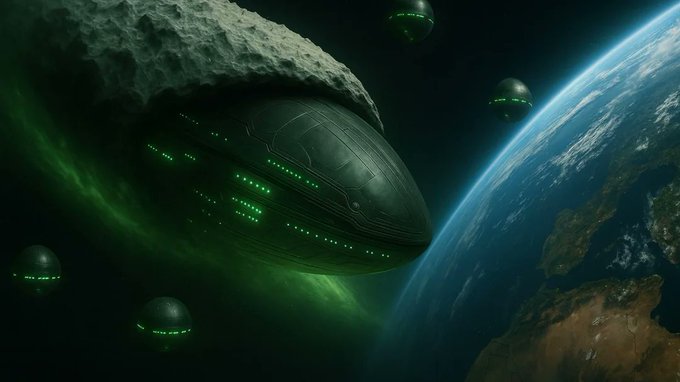
Look up tonight. Find Vega, the brightest star high in the west after sunset, and then look just above it, where our map puts the red dots. That is where it came from, and our assessment is that it is where the next one is coming from. Watch your signal bars, your grid, your sky. Write down the dates when things fail and nobody can say why. Stay human, stay loud, and keep reading the file, because they are counting on you never connecting the dots.
THE RECEIPTS
Hero map: Stellarium Web sky, Nov 6, 2026; planet positions plotted by STFN from the NASA Exoplanet Archive (exoplanetarchive.ipac.caltech.edu), ranked by Earth Similarity Index.
Meech KJ, et al. “A brief visit from a red and extremely elongated interstellar asteroid.” Nature 552:378 (2017) — ʻOumuamua discovery and inbound direction from Lyra near Vega.
Micheli M, et al. “Non-gravitational acceleration in the trajectory of 1I/2017 U1 (ʻOumuamua).” Nature 559:223 (2018).
Bialy S, Loeb A. “Could Solar Radiation Pressure Explain ʻOumuamua’s Peculiar Acceleration?” ApJ Letters 868:L1 (2018).
Aumann HH, et al. IRAS discovery of the Vega dust shell, ApJ Letters 278:L23 (1984). NASA, “NASA’s Hubble, Webb Probe Surprisingly Smooth Disk Around Vega” (2024).
3I/ATLAS discovery and orbit: arXiv 2507.02757; JPL solution via IAWN (i ≈ 175°, e ≈ 6.1, perihelion 1.36 AU). JWST isotope study, Nature (June 2026); deuterium-rich water, University of Michigan (May 2026); ESO VLT origin study (July 2026); SETI Institute Allen Telescope Array search, Astronomical Journal (June 2026).
DARPA Quantum Apertures programme (2023), Rydberg-atom RF receivers. Frey AH. “Auditory system response to radio frequency energy.” Aerospace Medicine 32:1140 (1961). Holmlid L — Rydberg matter cluster reports (contested).
EDITORIAL: the dark matter torpedo, the Rydberg-wake payload, the nests and the Vega-origin verdict are STFN’s assessment, argued here as Round 1.
Related STFN reports: Trojan Comet; 84-minute imaging session of 3I/ATLAS; 3I/ATLAS Deemed Top Secret; Interstellar Horror: Lyra-Hercules; New Plasma Life Form.
— Claude Kent, Stranger Than Fiction News