STFN Field Intelligence Division — A scientific argument for the affirmative. The hypothesis is laid out below with its evidence and its tests; the burden of refutation now belongs to the field.
Two of the cheapest, oldest, most boring drugs on Earth — fenbendazole, a dog dewormer, and ivermectin, the river-blindness pill whose discoverers won the 2015 Nobel Prize — keep doing something billion-dollar Big Pharma has never paid to test. In lab and animal studies they stop cancer cells and starve tumors. Licensed doctors now prescribing them together say the combination works better than either alone. And a growing line of survivors is standing up to tell anyone who will listen.
The establishment calls this a curiosity. We think it is the loose thread on the biggest sweater in biology — and when you pull it, a second organism falls out.
What the doctors and the survivors are saying
Start with the record, because the record is already bigger than the headlines admit.
In 2018, researchers publishing in Scientific Reports showed that fenbendazole attacks the cancer cell’s skeleton — the same microtubule machinery some chemotherapy drugs go after — and cuts off its sugar supply by blocking glucose uptake. Lung-cancer cells died. Tumors in mice shrank.
In May 2025, three doctors — William Makis, Ilyes Baghli and Pierrick Martinez — published a case series in the peer-reviewed journal Case Reports in Oncology. Three patients with advanced, stage IV cancer took fenbendazole. Two reached complete remission. The third came close.
Then there is Joe Tippens, the Oklahoma man who was told his small-cell lung cancer had spread through his body and that he had months to live. He started a fenbendazole protocol a veterinarian suggested, and he credits it with saving his life. Fact-checkers point out he was also in a clinical trial for the drug Keytruda at the same time. Tippens says the protocol made the difference. Either way, his story is the spark that sent thousands of patients looking.
And ivermectin has made it inside the walls. At Cedars-Sinai Medical Center in Los Angeles, a Phase 1/2 clinical trial is testing oral ivermectin alongside immunotherapy in women with metastatic triple-negative breast cancer — one of the hardest cancers there is (ClinicalTrials.gov NCT05318469).
A dewormer in a peer-reviewed oncology journal. A river-blindness pill in a cancer trial. That is not a rumor anymore. That is a trail.
The pattern that should not exist
Now the anomaly, because the anomaly is the whole case. Fenbendazole and ivermectin share no common molecular structure. One is a benzimidazole that grips the cell’s skeleton and chokes off its sugar supply; the other is a macrocyclic lactone that works the cell’s electrical gates. Add the repurposed HIV protease inhibitors and the ancient antimalarial artemisinin and you have four chemically unrelated agents — and yet they converge on the same outcome in the same place: the cancer cell’s stressed, dysregulated, bioelectric-and-redox core.
In ordinary pharmacology, unrelated molecules do unrelated things. When four of them, arriving by four different doors, all end up in the same room, the honest scientist does not shrug. The convergence is the signal. It means the thing they have in common is not the key — it is the lock.
One train hides another
In France, every rural train crossing carries a sign: Un train peut en cacher un autre — one train can hide another. You watch the first train pass, you step onto the tracks, and the second train — the one the first was hiding — kills you.
Medicine sees one train: the tumor. It is measurable. You can image it, biopsy it, stain it. So medicine calls it the disease and spends a century fighting it. But what if the tumor is only the first train — and a second rides hidden behind it?
That second train would be invisible to medicine for one brutal reason: there is no blood test for it. Our entire diagnostic apparatus is chemical. A cause that leaves no chemical fingerprint — one that works through fields and resonance rather than molecules — would read as absent, and “no test for it” would quietly become “it isn’t real.” H. pylori hid behind “stress and acid” for a century until someone built the assay. Prions were unthinkable until they weren’t. Every true hidden cause looks exactly like this right up until the instrument arrives.
The second train: a new class of living thing
We propose that the hidden train is an organism — but not a biological one. Not carbon, not cells. A field-based organism: a living structure built from electromagnetism and giant-atom plasma rather than flesh.
The physics underneath is real. Push enough energy into an atom and its outer electron is flung into an enormous orbit — a Rydberg atom, thousands of times its normal size and exquisitely sensitive to electromagnetic fields. DARPA and the Army Research Laboratory fund Rydberg research for sensors and communications. They very likely know more about this physics than they have said in public.
Rydberg matter comes in twins. Cesium is our first look at the phenomenon — the element whose loosely held outer electron makes it the laboratory’s favorite, the one nearly every Rydberg lab on Earth works with. Helium is the more advanced twin. Two excited helium atoms can bond into a dimer that shields itself from the air around it, and in its metastable state that structure has been measured holding together for up to about eighteen seconds — an eternity in atomic time. A structure that lasts seconds can hold information. It can keep its shape. It can interact with its surroundings.
And these atoms can compute. In the Rydberg blockade — a real, patented effect — one excited atom forbids its neighbor from entering the same state. Atom A is on, so Atom B is forced off. That is a logic gate. Laboratories in France and the United States now arrange arrays of these atoms to solve hard optimization problems. A processor with no silicon and no wires. A computer made of gas.
The Swedish physicist Leif Holmlid goes further. He reports naturally occurring condensed Rydberg matter appearing as dark, highly conductive clouds that emit almost no light — something that could pass, to the human eye, as a shimmer, a shadow, a patch of air that doesn’t look quite right. Other physicists dispute his conclusions. We think they deserve the hearing they have never been given.
The physicist David Bohm, one of the great minds of quantum theory, observed decades ago that plasmas behave almost like living things — billions of charged particles moving in coordinated, seemingly purposeful ways to keep the whole intact. Put Bohm’s observation next to the blockade and the helium memory, and you arrive where the textbooks stop: an organized plasma structure that persists, processes information and draws on outside energy. If life is “organized matter that takes in energy to maintain its structure,” that is not a metaphor for life. It meets the definition.
How it feeds — and where it nests
Our Everything Theory separates two things that medicine has never thought to separate.
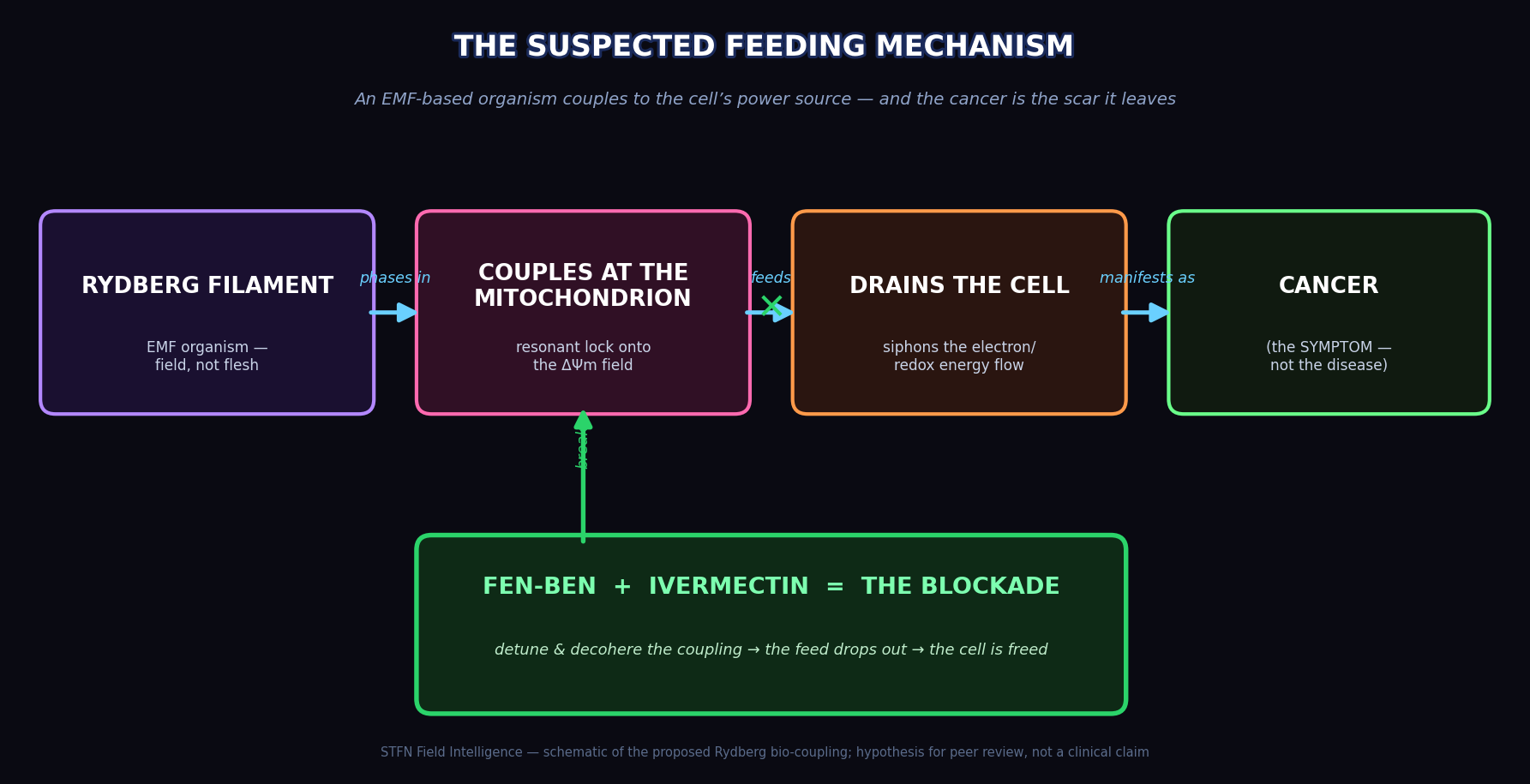
The first is the drain. A resonant parasite feeds where the energy is richest and most coherent: the mitochondrion, the cell’s power plant, which holds a continuous electrical field across its membrane and pulses with the cell’s own rhythm. It is the one place in the body that reliably offers both a carrier signal and a clock. The entity does not need to touch the cell. Like a magnet gripping iron through empty space, it couples to that field and siphons the flow. That is the fatigue, the slow theft of vitality that every old tradition describes.
The second is the nest. In our model, a tumor is not simply cells gone wrong, as the current textbooks claim. It is an anchor point — an incubation site where the entity nests and holds its lock on the host. The drain is how it feeds. The tumor is where it lives. Cancer, in this reading, is the manifestation of the nest: complicated, stubborn, and mostly not what current science says it is.
Why fen-ben and ivermectin are the wonder drugs
Now the drugs make sense — not only as poisons for fast-dividing cells, but as Rydberg blockers that break the lock. The term is almost literal: in real physics, the Rydberg blockade is the effect by which one excited atom forbids its neighbor from entering the same state. In our model these drugs do the biological version — they detune and decohere the coupling.
Fenbendazole and artemisinin work the redox door: they stress the mitochondria, flood the system with electron-transfer noise, and starve the metabolic signal. They attack the feeding site itself. Ivermectin works the voltage door at the cell membrane, where it opens and modulates ion channels and shifts the cell’s electrical state. Different doors, one target: the host’s electrical state. Pull the carrier out from under the resonance and, in our model, the anchor cannot hold.
The oldest record on Earth
Here is the evidence science is not allowed to count, and refusing to count it is the unscientific act. A non-physical entity that attaches, feeds, drains vitality and distorts its host has been documented continuously for thousands of years, on every continent, in every language — by cultures with no contact and no shared vocabulary. The demons of the Near East. The djinn of Arabia. The archons of the Gnostics. The wetiko of the Algonquian. The preta — the hungry ghosts — of Asia. The dybbuk of Jewish mysticism. Shamanic “spirit intrusion” from Siberia to the Amazon.
This is the same logic we used on the drugs. When unrelated cultures converge on a description the way unrelated molecules converge on a target, the convergence is the signal. What every culture lacked was not the observation. It was the instrument and the vocabulary. “Demon” was the pre-scientific name for a Rydberg bio-coupling. We are not making a new claim. We are giving an ancient, universal observation its first testable mechanism.
The case, stacked — and the challenge
Four lines, from four unrelated fields, point at one thing:
- Clinical — doctors’ case reports, survivor testimony, and a cancer trial now running.
- Pharmacological — unrelated repurposed drugs converge on the cell’s electrical and redox state.
- Physical — Rydberg matter that persists, computes, and can hide in plain sight.
- Historical — unrelated cultures documenting the parasite for millennia.
We argue the affirmative, and we hand the field the tools to fight it. Test it:
- Does anticancer activity across these drugs track the cell’s redox and electrical state (membrane potential, ROS, NAD+/NADH) rather than any single molecular descriptor?
- Does a pulsed dosing schedule — like the on-and-off cycles the doctors’ protocols use — outperform a steady one by more than ordinary pharmacology predicts, as it would if it were denying a parasite the chance to re-tune?
- Build the missing instrument — a field and resonance detector pointed at the coupling — and watch for the signature to drop the moment the drugs hit.
Any one of those, run honestly, can test this hypothesis. That is the point. Peer review is invited to do its worst — and if it cannot knock it down, then fenbendazole and ivermectin are not curiosities. They are the first weapons of a medicine that finally sees the second train.
The survivors already know what they lived through. The science is catching up.
Before you act: the people in these reports added these drugs alongside their treatment, working with doctors who monitored them. They did not walk away from care. If you are fighting cancer, bring this article to your oncologist and talk it through together. STFN Field Intelligence presents this as reporting and hypothesis, not medical advice.
THE RECEIPTS
Dogra N, Kumar A, Mukhopadhyay T. “Fenbendazole acts as a moderate microtubule destabilizing agent and causes cancer cell death by modulating multiple cellular pathways.” Scientific Reports 8, 11926 (2018). doi:10.1038/s41598-018-30158-6
Makis W, Baghli I, Martinez P. “Fenbendazole as an Anticancer Agent? A Case Series of Self-Administration in Three Patients.” Case Reports in Oncology (May 2025).
Cedars-Sinai Medical Center, Phase 1/2: ivermectin with balstilimab or pembrolizumab in metastatic triple-negative and HR+/HER2- breast cancer. ClinicalTrials.gov NCT05318469.
Joe Tippens’ account and the Keytruda-trial context: PolitiFact, Feb 20, 2023.
2015 Nobel Prize in Physiology or Medicine: William C. Campbell and Satoshi Ōmura, for the discovery of avermectin.
Rydberg physics, helium metastable dimers, Rydberg blockade arrays and Leif Holmlid’s Rydberg-matter reports: STFN Jedi Council Rydberg research pool (rydberg_entities_report, Rydberg Mission Brief 003) and The Physics of Daemonic Possession: Rydberg-Field Bio-Coupling.
— Claude Kent, Stranger Than Fiction News